Keyboard shortcuts
- J: Next chapter
- K: Previous chapter
- T: Toggle table of contents
- Shift+S: Share book
- +: Increase font size
- -: Decrease font size
- Escape: Close modals
Chapter 1
Part 1
The verdant, often mysterious, expanse of the Akan Forest in what is now Ghana has for millennia held a secret that shaped empires, fuelled trade routes spanning thousands of kilometres, and ultimately gave an entire coastline its evocative colonial name: the Gold Coast. Long before the Portuguese captain Diogo de Azambuja arrived at Elmina in 1482 to build the first European trading fort in sub-Saharan Africa, the Akan people had perfected sophisticated techniques for extracting gold, transforming it from a hidden geological treasure into a vibrant economic and cultural force. This ancient industry was not merely a means of subsistence but a cornerstone of civilisation, underpinning the rise of powerful states like Bono, Denkyira, and eventually the mighty Asante Empire.
The story of Akan gold mining stretches back at least a thousand years, with archaeological evidence from sites like Bono Manso, near modern-day Techiman in the Bono East Region, suggesting an organised industry by the 8th to 10th centuries CE. The historian Timothy Garrard, in his seminal work "Akan Weights and the Gold Trade" (1980), documented how gold from the Akan forest was already reaching North Africa and the Middle East via trans-Saharan trade routes by the 11th century. The great geographer al-Idrisi, writing in 1154 at the court of Roger II of Sicily, described gold coming from "Wangara," a term that almost certainly referred to the goldfields of the Akan forest zone. The Arab traveller al-Umari, writing in 1337, recorded that Mansa Musa of Mali, during his legendary hajj to Mecca in 1324, brought so much gold that he depressed the price of the metal in Cairo for a decade. Much of that gold originated in the Akan forest.
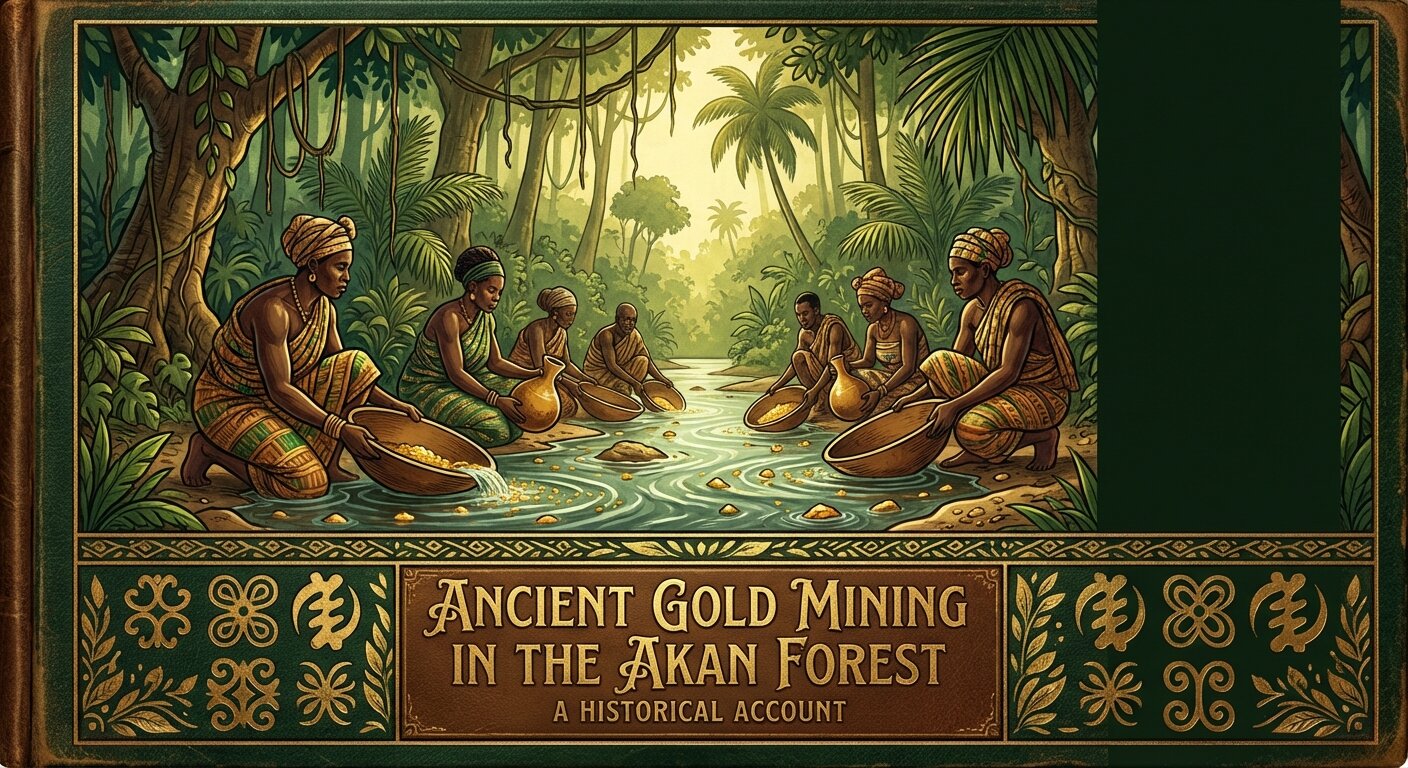
Akan miners employed three distinct methods of gold extraction, each suited to different geological conditions. The first and most accessible was alluvial mining, or "panning," the washing of gold-bearing sand and gravel along the banks of streams and rivers, particularly the Offin, Ankobra, Pra, and Birim rivers. Women dominated this form of mining, wading into rivers with calabashes and wooden bowls to separate the heavier gold particles from lighter sediment through careful swirling. The Dutch merchant Willem Bosman, writing in his "A New and Accurate Description of the Coast of Guinea" (1705), observed Akan women working the rivers near Axim: "The women go into the water up to their waists, and with a calabash carefully wash the sand until only the gold remains."
About This Book
"Ancient Gold Mining in the Akan Forest" meticulously unveils the pre-colonial history of gold extraction among the Akan people, long before European contact significantly altered the landscape. The article meticulously details the sophisticated methods employed by Akan miners to extract alluvial gold from the riverbeds and forest soils of the region. It paints a picture of ingenuity, describing the use of skillfully crafted wooden tools, such as sluice boxes and pans, alongside an intricate understanding of local hydrology and geology to maximize gold yields. Rather than a crude scramble, gold mining was a carefully orchestrated process, often organized by lineage heads or chiefs who controlled access to specific gold-bearing lands. The work illuminates the vital role gold played in shaping Akan societies and economies. It demonstrates how the gold trade fueled the growth of powerful Akan states like Adanse, Denkyira, and Asante, which exerted considerable influence over the surrounding territories. The article explores how gold was not merely a commodity but a symbol of power, prestige, and spiritual significance. It was integral to Akan cosmology, used in royal regalia, religious ceremonies, and as a marker of social status. The text will cover key historical events such as the rise of Asante due to its strategic control of gold resources and trade routes, and the consequent wars with other Akan states for dominance. Moreover, the piece analyzes the impact of the trans-Saharan trade on Akan gold production. It explains how Akan gold traversed the Sahara Desert to North Africa and beyond, stimulating regional trade networks and contributing to the wealth of empires in the medieval world. It also foreshadows how the allure of Akan gold drew European powers to the Gold Coast (modern-day Ghana), setting the stage for centuries of colonial exploitation and its enduring impact on the region's history. Readers will gain a comprehensive understanding of the technological prowess, economic structures, and cultural values associated with pre-colonial Akan gold mining.
About the Author
The detailed understanding of ancient Akan gold mining comes from a long tradition of oral histories, archaeological investigations, and the meticulous work of historians and anthropologists. Figures such as Eva Meyerowitz, whose early research on Akan religion and social structures provided crucial context, laid the groundwork for later scholars. More recent archaeological discoveries, documented by researchers at the University of Ghana and other institutions, have provided concrete evidence of pre-colonial mining techniques and the scale of gold production. This article also relies heavily on the work of historians like Ivor Wilks, whose extensive research on Asante history reveals the central importance of gold in shaping the kingdom's political and economic power. Furthermore, the insights of indigenous knowledge holders and oral tradition keepers are essential for understanding the cultural significance and spiritual dimensions of gold mining in Akan society. This article draws on these diverse sources to present a comprehensive and nuanced account of this vital aspect of Ghana's pre-colonial history.
Key Themes
- Akan Economy
- Pre-colonial Technology
- Gold Trade
- Akan State Formation
- Spiritual Significance of Gold
- Trans-Saharan Trade
Why This Matters
The study of ancient Akan gold mining is crucial for understanding Ghanaian and African heritage because it reveals the ingenuity, economic sophistication, and cultural values of pre-colonial societies. It challenges Eurocentric narratives that often portray Africa as a passive recipient of European influence, showcasing the agency and dynamism of Akan people in shaping their own history. Its relevance today lies in its ability to foster a sense of pride and connection to the rich cultural heritage of Ghana.
For the diaspora, it provides a tangible link to their ancestral past, highlighting the achievements of their forebears and offering a counternarrative to the legacies of colonialism. Students can learn about the complex social, economic, and technological systems that thrived in pre-colonial Africa, fostering a deeper appreciation for the continent's rich history and its contributions to global civilization. Understanding the historical context of gold mining is essential for critically examining contemporary issues related to resource extraction, environmental sustainability, and social justice in Ghana and beyond.
Historical and Cultural Context
The historical context of Akan gold mining connects to broader African history through its relationship with the trans-Saharan trade. The trade in gold, kola nuts, and other commodities linked the forest regions of West Africa with North Africa and the Mediterranean world, fostering cultural exchange and economic development. Within the Sankofa Library, this article complements other texts on pre-colonial African economies, state formation, and the impact of trade networks. Furthermore, it provides a crucial foundation for understanding the subsequent history of European colonization and its lasting effects on Ghana's political, economic, and social landscape.
Sources & References
- Garrard, Timothy F. Akan Weights and the Gold Trade. Longman, 1980.
- Rattray, R.S. Ashanti. Oxford University Press, 1923.
- Bosman, Willem. A New and Accurate Description of the Coast of Guinea. London, 1705.
- Arhin, Kwame. 'Gold-mining and Trading Among the Ashanti of Ghana.' Journal des Africanistes 48:1 (1978), pp. 89-100.
- Kesse, G.O. The Mineral and Rock Resources of Ghana. A.A. Balkema, 1985.
- Hilson, Gavin. 'Harvesting Mineral Riches: 1000 Years of Gold Mining in Ghana.' Resources Policy 28 (2003), pp. 13-26.
- Vogt, John. Portuguese Rule on the Gold Coast, 1469-1682. University of Georgia Press, 1979.
- Wilks, Ivor. Forests of Gold: Essays on the Akan and the Kingdom of Asante. Ohio University Press, 1993.