
Keyboard shortcuts
- J: Next chapter
- K: Previous chapter
- T: Toggle table of contents
- Shift+S: Share book
- +: Increase font size
- -: Decrease font size
- Escape: Close modals
Chapter 1
Part 1
## The Castle Schools: Education as Colonial Instrument
Ghana's formal educational history begins in paradox: the first schools on the Gold Coast were established at the slave trading forts. The Dutch West India Company established a school at Elmina Castle in 1644, primarily to educate the children of African women who had relationships with Dutch traders. The British at Cape Coast Castle similarly maintained a school for mixed-race children and the children of African trading partners. These were not institutions of liberation. They were instruments of the colonial economy, designed to produce interpreters, clerks, and mediators who could facilitate the profitable business of trade, which in the eighteenth century included the trade in human beings.
The children who passed through these castle schools occupied an uncomfortable middle position in Gold Coast society: educated enough to be useful to European traders, not European enough to be accepted as equals, and sufficiently separated from their African communities by their literacy and Christianity to be in permanent tension with traditional authority. This ambiguity, the educated African who belongs fully neither to the European world whose education he has received nor to the African world whose traditions he has partially absorbed, would become a recurring theme in Ghanaian literature and politics for the next two centuries.
The Basel Mission, arriving in 1828, took a more systematic approach to education. The Swiss missionaries who established themselves at Akropong in the Eastern Region in 1835 created not just a primary school but the Akropong Teacher Training Seminary, founded in 1848 and still operating today as the Presbyterian College of Education. The Basel Mission's educational approach was unusual for its era in several respects: it committed to teaching in African languages, developing written forms for Twi and Ga that created the foundation for later Ghanaian literature in those languages. It also emphasized practical education in agriculture and trades alongside the reading and mathematics curriculum, believing that education should improve material as well as spiritual conditions.
The Wesleyan Methodist Mission, establishing itself along the coast from 1835, took a more English-language-focused approach. Methodist schools in Cape Coast, Anomabo, and other coastal towns produced a generation of educated Fante men who would become the first generation of professional Ghanaians: lawyers, journalists, doctors, and the political leaders of the incipient independence movement. James Emman Kwegyir Aggrey, born in Anomabo in 1875 and educated in Methodist schools before going on to study in the United States, became perhaps the most celebrated educator of the early twentieth century, a figure of pan-African intellectual stature whose philosophy of racial harmony and mutual uplift through education shaped generations of teachers and administrators.
## Colonial Education: Design and Subversion
By the late nineteenth century, the British colonial government had begun to take a more systematic interest in education, both to regulate the missionary schools and to ensure that the educational system served colonial economic needs. The Education Ordinance of 1887 established an inspectorate and funding mechanisms for approved schools, creating the bureaucratic framework for what would become a colonial educational system.
The colonial educational philosophy as articulated by British administrators emphasized practical and vocational training for African students rather than the academic education available to European children. The Phelps-Stokes Commission report of 1920, which surveyed African education across the continent, explicitly recommended adapting education to rural African life, meaning agriculture and trades rather than university preparation. This recommendation aligned conveniently with colonial economic interests: an agricultural Africa producing raw materials for European factories needed farmers and artisans, not lawyers and doctors who might challenge colonial authority.
About This Book
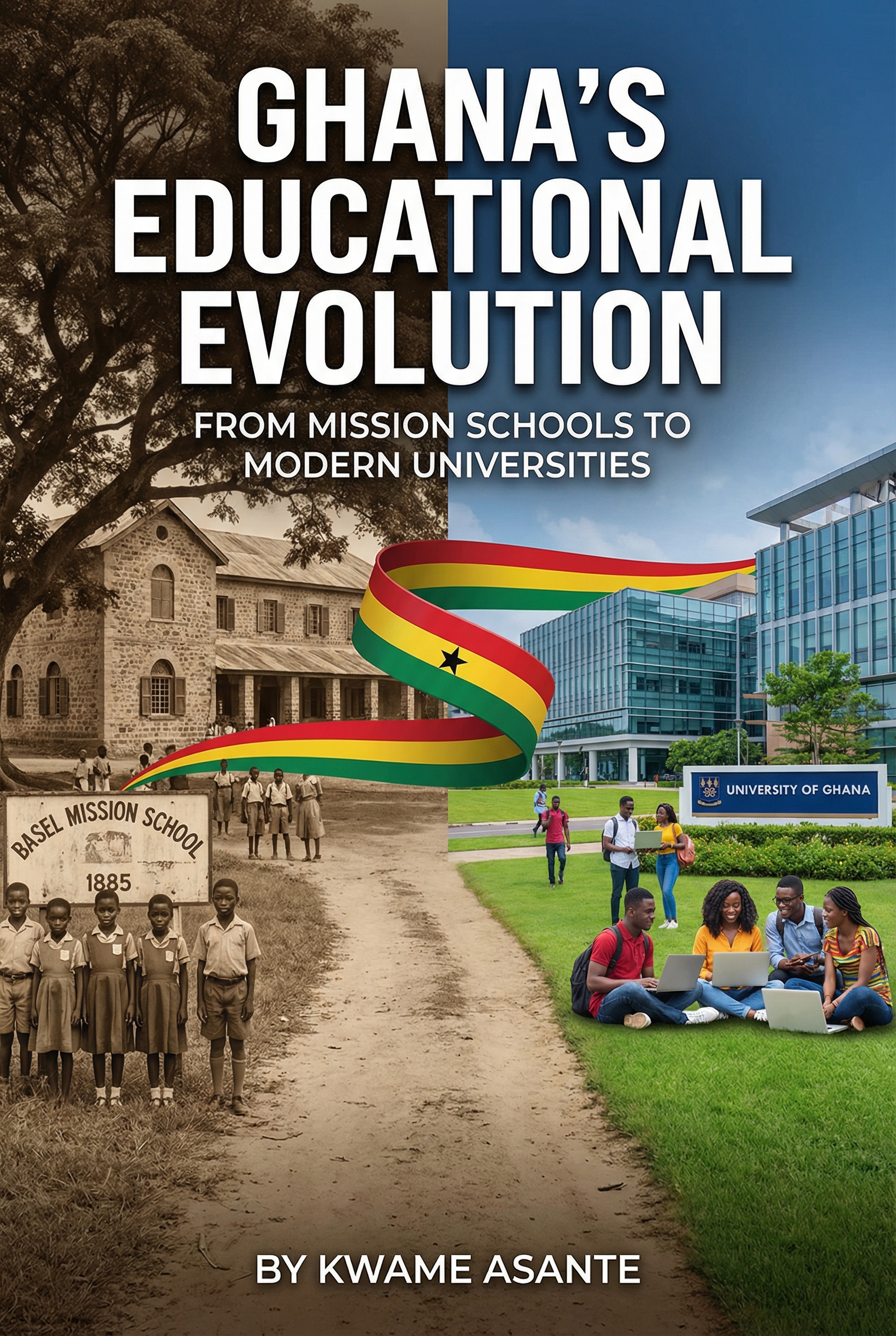
"From Mission Schools to Silicon Savannah" offers a comprehensive exploration of Ghana's educational journey, beginning with the earliest formal schooling initiatives in the 17th century through the present day digital revolution. The book meticulously charts the evolution of educational philosophies, institutions, and policies, paying close attention to their socio-political context. Initially, European trading companies established schools within the coastal forts, primarily to educate mulatto children and train local staff for administrative roles. Later, missionary societies such as the Basel Mission and the Wesleyan Methodist Missionary Society established schools like Mfantsipim School and Wesley Girls' High School, aiming to evangelize and provide vocational skills. These institutions, while instruments of colonial influence, also became crucibles for emerging nationalist thought, nurturing future leaders such as Kwame Nkrumah and J.B. Danquah. The book highlights the pivotal role of Ghanaian intellectuals and activists who challenged the limitations of colonial education and advocated for a curriculum that reflected African history, culture, and values. Nkrumah's Accelerated Development Plan for Education in the 1950s marked a paradigm shift, prioritizing mass education and establishing the University of Ghana to produce skilled professionals for national development. The text analyzes the subsequent periods of educational reforms, including the impact of Structural Adjustment Programs in the 1980s, the reintroduction of the Senior Secondary School system, and the ongoing debates surrounding access, quality, and relevance. The book also examines the rise of private schools and universities, the adoption of ICT in education, and the challenges of bridging the digital divide between urban and rural areas. Case studies from Accra, Cape Coast, Kumasi, Tamale, and diverse rural regions paint a rich portrait of local experiences and regional disparities within the national educational landscape. "From Mission Schools to Silicon Savannah" ultimately argues that Ghana's educational trajectory is a dynamic and ongoing process of negotiation, adaptation, and innovation, shaped by both internal aspirations and external pressures.
About the Author
This account builds upon the rich tradition of Ghanaian educational historiography. Scholars like Philip Foster ("Education and Social Change in Ghana"), Magnus Sampson ("Making Education Relevant in Ghana"), and C.K. Graham ("The History of Education in Ghana") laid the groundwork by documenting the colonial and post-colonial eras. More recent works by Kwesi Kwaa Prah have also been important in understanding the role of language in education. Their research emphasized the impact of missionary activities, government policies, and local agency in shaping the educational system. Building on this tradition, this book draws on archival sources, oral histories, and contemporary policy documents to offer a fresh perspective on Ghana's educational evolution, incorporating insights from educational theory, sociology, and development studies. It recognizes the contributions of countless teachers, students, policymakers, and community members who have shaped the educational landscape.
Key Themes
- Colonialism and Education
- Nationalism and Educational Reform
- Language and Literacy
- Gender and Access to Education
- Technical and Vocational Training
- The Digital Divide
- Education and National Development
Why This Matters
The story of Ghanaian education is critical for understanding not only Ghana's development but also the broader post-colonial experience in Africa. Education has been both a tool of domination and a means of liberation, reflecting the complex interplay of power, knowledge, and identity. Understanding the historical roots of Ghana's educational system helps to contextualize contemporary challenges such as inequality, unemployment, and the brain drain. For the diaspora, this narrative offers valuable insights into their ancestral heritage and the struggles for self-determination. For students, particularly in African Studies, it provides a case study of how education can be harnessed for social, economic, and political transformation. By examining the successes and failures of the past, this book empowers readers to envision a more equitable and sustainable future for education in Ghana and beyond.
Historical and Cultural Context
Ghana's educational history is intertwined with the Pan-African movement, exemplified by figures like Marcus Garvey and W.E.B. Du Bois, who championed education as a means of empowering people of African descent worldwide. The establishment of the West African Examinations Council (WAEC) also links to regional collaborations in education. Furthermore, Ghana's early adoption of ICT in education resonates with broader African efforts to leverage technology for development. Within the Sankofa Library, this book complements texts on colonial history, Pan-Africanism, and development economics, offering a holistic understanding of Ghana's journey toward modernization and self-reliance.