
Keyboard shortcuts
- J: Next chapter
- K: Previous chapter
- T: Toggle table of contents
- Shift+S: Share book
- +: Increase font size
- -: Decrease font size
- Escape: Close modals
Chapter 1
Part 1
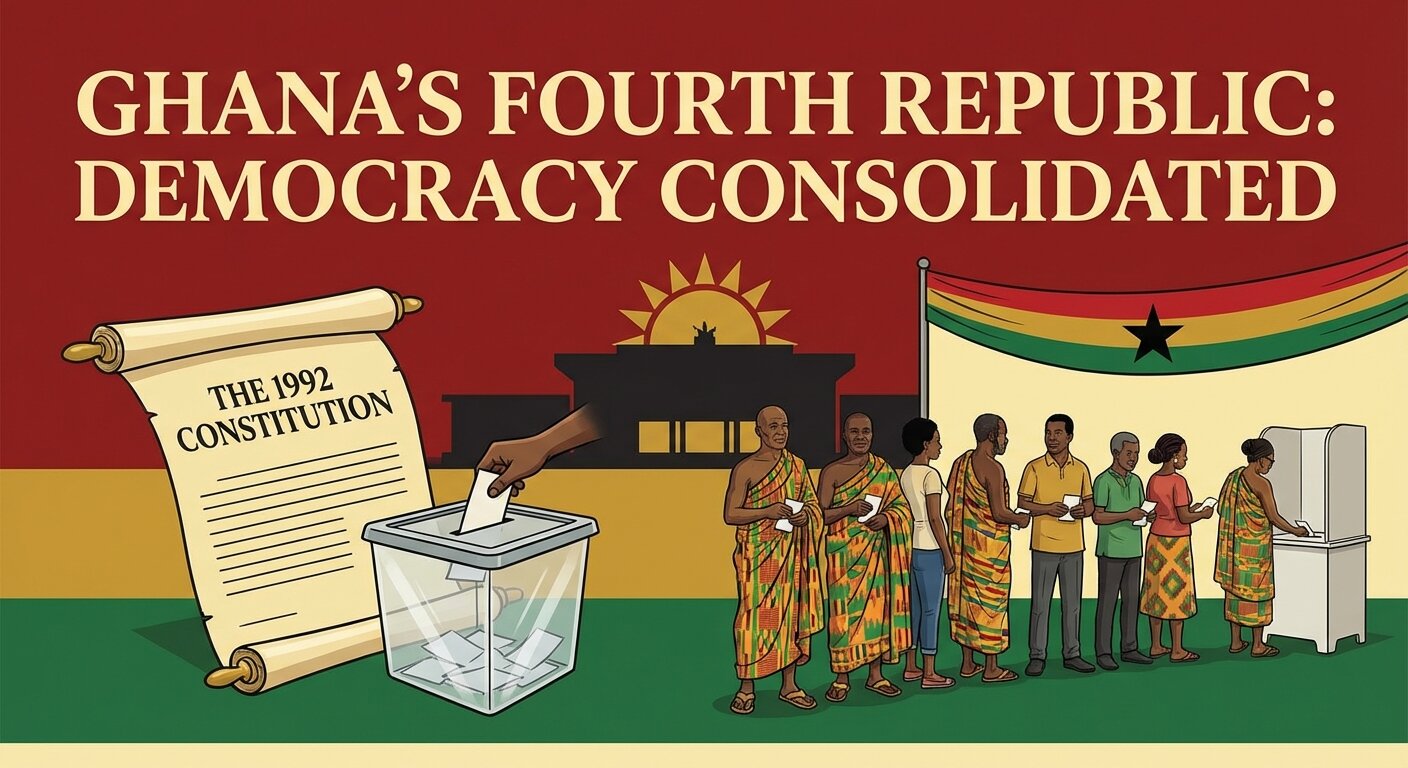
Ghana's journey to democratic stability following decades of political upheaval is a compelling narrative, culminating in the establishment of the Fourth Republic in January 1993. This period marked a profound shift from military rule to a constitutional democracy, guided by the landmark 1992 Constitution. This foundational document, approved by a national referendum in April 1992 with an overwhelming 92 percent of votes cast in favor, laid the framework for a multiparty system, robust checks and balances, and a commitment to human rights, setting Ghana on an irreversible path towards democratic consolidation. The constitution enshrined principles of separation of powers among the executive, legislature, and judiciary, and crucially, established independent bodies such as the Electoral Commission, the Commission on Human Rights and Administrative Justice, CHRAJ, and the National Commission for Civic Education, NCCE, all designed to safeguard the nascent democracy and ensure accountability.
The transition was spearheaded by Flt. Lt. Jerry John Rawlings, who had led the Provisional National Defence Council, PNDC, military government since 1981. After overseeing the constitutional drafting process and the referendum, Rawlings contested and won the presidential elections in November 1992 under the banner of the National Democratic Congress, NDC, a party formed from the PNDC's political apparatus. His victory, though disputed by opposition parties who cited alleged irregularities and subsequently boycotted the parliamentary elections in December 1992, initiated the Fourth Republic on January 7, 1993. The initial years were characterized by the difficult task of economic recovery through structural adjustment programs and the gradual institutionalization of democratic practices. The 1996 general elections saw a more vibrant multiparty contest, with Rawlings again facing John Agyekum Kufuor of the New Patriotic Party, NPP. Rawlings secured a second four-year term with 57.4 percent of the vote, demonstrating the growing acceptance of electoral politics, even amidst continued political contestation and the development of a strong two-party system.
About This Book
"Ghana's Fourth Republic: Democracy Consolidated" offers a comprehensive examination of Ghana's successful navigation of democratic governance since 1993. The article meticulously charts the establishment and strengthening of democratic institutions under the 1992 Constitution, a document designed to prevent the excesses of previous regimes and safeguard fundamental rights. A central theme is the evolution of multiparty democracy, tracing the shifts in political allegiances, the rise of new political parties, and the increasing sophistication of electoral processes. Key events highlighted include the landmark 2000 election, which saw the peaceful transfer of power from Jerry John Rawlings' National Democratic Congress (NDC) to John Agyekum Kufuor's New Patriotic Party (NPP) -- a watershed moment that debunked pervasive anxieties about political instability in post-colonial Africa. The narrative continues through the subsequent elections of 2008, 2012, and 2016, emphasizing the increasing robustness of Ghana's electoral commission and judiciary in mediating disputes and ensuring fair outcomes. Particular attention is given to the 2012 election petition, where the NPP challenged the results in the Supreme Court, ultimately accepting the court's verdict. The article also assesses the role of civil society organizations, the media, and religious institutions in holding political leaders accountable and promoting good governance. Readers will gain insight into the constitutional checks and balances, the deepening of political participation, and the socio-economic factors contributing to Ghana's relative stability. Furthermore, the article explores the challenges that remain, including corruption, income inequality, and the need for further reforms to strengthen institutions and promote inclusive growth. It provides a balanced perspective, celebrating the successes while acknowledging the ongoing work necessary to sustain and deepen democratic consolidation.
About the Author
The scholarship on Ghana's Fourth Republic draws upon a rich tradition of Ghanaian political scientists, historians, and legal scholars dedicated to documenting and analyzing the nation's post-independence journey. Figures like Professor Kwame Boafo-Arthur, whose work examines democratic transitions and electoral politics, and Professor E. Gyimah-Boadi, a leading voice on governance and public opinion in Africa, have been instrumental in shaping our understanding. The contributions of constitutional lawyers such as Nana Akufo-Addo (before his presidency) have also been vital in interpreting and shaping the legal framework of the Fourth Republic. This article builds upon this foundation of scholarly inquiry, utilizing archival research, statistical data, and qualitative analysis to provide a comprehensive account of Ghana's democratic consolidation. The work reflects a commitment to rigorous research and a nuanced understanding of the complexities of Ghanaian politics.
Key Themes
- Constitutionalism
- Multiparty democracy
- Peaceful transfer of power
- Electoral integrity
- Judicial independence
- Civil society
- Good governance
Why This Matters
The story of Ghana's Fourth Republic is profoundly significant for understanding both Ghanaian and African heritage because it showcases the potential for democratic governance on the continent. It serves as a counter-narrative to stereotypical portrayals of Africa as perpetually mired in conflict and authoritarianism. The peaceful transitions of power -- particularly those in 2000 and subsequent elections -- demonstrate the maturation of political institutions and a growing commitment to democratic principles among Ghanaian citizens.
For the diaspora, this narrative offers a powerful symbol of hope and inspiration, demonstrating that African nations can build stable and prosperous societies. For students, the Fourth Republic provides a case study in democratic consolidation, illustrating the challenges and opportunities involved in building and sustaining democratic institutions in a post-colonial context. Engaging with this story allows readers to understand the agency of Ghanaians in shaping their own political destiny and the importance of civic participation in safeguarding democratic values. It underscores the enduring quest for self-determination and the ongoing struggle for good governance in Africa.
Historical and Cultural Context
The establishment of Ghana's Fourth Republic is intimately linked to the broader history of post-colonial Africa and the global wave of democratization that swept through the late 20th century. Following periods of military rule and single-party systems, Ghana's transition to multiparty democracy reflected a wider trend across the continent. The adoption of the 1992 Constitution and the subsequent peaceful transfers of power can be understood within the context of Pan-African ideals of self-determination and good governance. The successes and challenges of Ghana's Fourth Republic offer valuable lessons for other African nations striving to consolidate democracy and promote sustainable development. This narrative complements other materials within the Sankofa Digital Heritage Library documenting the struggles for independence, the experiments with different forms of governance, and the ongoing efforts to build a more just and equitable society in Africa.
Sources & References
- Gyimah-Boadi, E. (2004). Democratic Reform in Africa: The Case of Ghana. University of Ghana Press.
- Nugent, P. (2012). Ghana: A Political History since 1957. Palgrave Macmillan.
- Ayee, J.R.A. (2000). The 2000 General Elections in Ghana. Woeli Publishing Services.
- Boafo-Arthur, K. (2007). Ghana: One Decade of the Fourth Republic. Zed Books.
- Mohan, G. (2007). The Political Economy of Ghana's Fourth Republic. Palgrave Macmillan.