
Keyboard shortcuts
- J: Next chapter
- K: Previous chapter
- T: Toggle table of contents
- Shift+S: Share book
- +: Increase font size
- -: Decrease font size
- Escape: Close modals
Chapter 1
Roots of Dispersal: From Coromantee Captives to Independence-Era Brain Drain
The Ghanaian diaspora is rooted in the Atlantic slave trade, when captives from Akan, Ga, Ewe, and Fante communities were shipped through Cape Coast Castle and Elmina to the Americas between the sixteenth and nineteenth centuries. The Coromantee — named after the Gold Coast port of Kormantse — became feared throughout the Caribbean for their rebellious spirit; the 1760 Tacky's Rebellion in Jamaica, led by an Akan chief, involved 1,500 enslaved fighters and terrified the British colonial establishment. In South Carolina and Georgia, Akan cultural practices survived in the Gullah-Geechee communities, where linguists have traced Twi and Ga loanwords in the creole language. W.E.B. Du Bois, whose great-grandfather was likely of Gold Coast origin, made Ghana his spiritual home, accepting Nkrumah's invitation in 1961 and dying in Accra on 27 August 1963, the eve of the March on Washington. Maya Angelou lived in Ghana from 1962 to 1965, writing about her experience in "All God's Children Need Traveling Shoes" (1986). The post-independence brain drain began almost immediately: between 1957 and 1966, thousands of Ghanaian students and professionals left for Britain and the United States, many on government scholarships that were never returned. By 1969, the Busia government's Aliens Compliance Order — aimed at expelling foreigners — paradoxically accelerated Ghanaian emigration as the economy contracted. The pattern was set: economic crisis at home, opportunity abroad.
About This Book
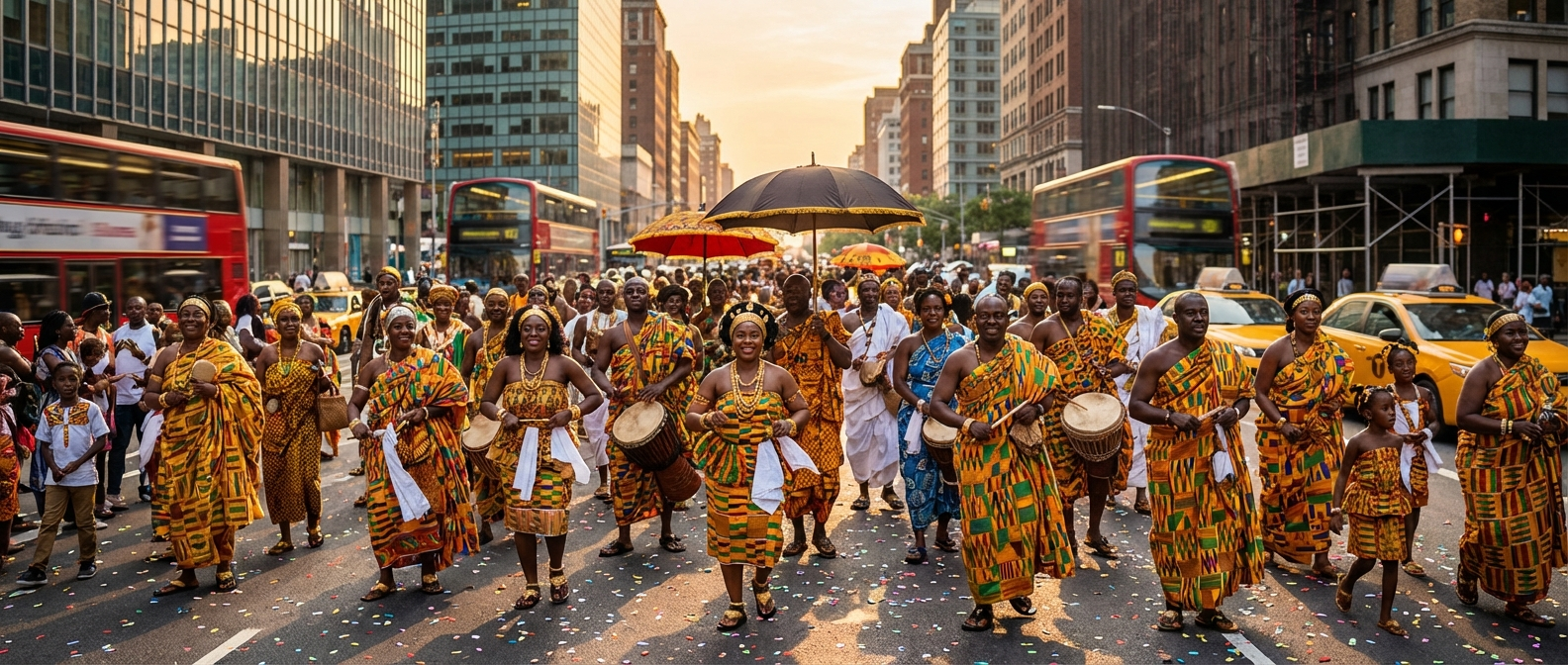
"Ghanaian Diaspora: From Bronx to Brixton" offers a comprehensive exploration of the multi-faceted experiences of Ghanaians who have migrated to various parts of the world, focusing specifically on the vibrant communities that have taken root in the Bronx, New York, and Brixton, London. The article avoids romanticizing migration, instead presenting a nuanced account of the push and pull factors driving emigration from Ghana, including economic hardship, limited educational opportunities, and political instability that characterized certain periods of the nation’s history, particularly in the 1970s and 1980s. The narrative traces the establishment of Ghanaian communities abroad, highlighting the pivotal roles of churches -- often Pentecostal and charismatic -- and traditional associations in providing social support, preserving cultural identity, and facilitating integration into new societies. These institutions serve as vital links to Ghana, reinforcing cultural values, language, and traditions among subsequent generations. The article analyzes the economic contributions of the diaspora, emphasizing the substantial impact of remittances on Ghana's economy, which provide crucial financial support to families and contribute significantly to national development. It further explores the various ways the diaspora maintains strong ties to Ghana, including investments in businesses and real estate, philanthropic initiatives, and active participation in Ghanaian politics. The study also acknowledges the challenges faced by Ghanaians in the diaspora, such as discrimination, cultural adaptation, and the complexities of navigating dual identities. It sheds light on the diverse experiences within the diaspora, considering variations based on socioeconomic status, educational background, and generation. Through a combination of historical analysis, sociological insights, and personal narratives, this book provides a compelling portrait of the Ghanaian diaspora and its enduring impact on both Ghana and the host countries. Readers will gain a deeper understanding of the motivations, challenges, achievements, and ongoing connections that define this dynamic global community. Figures like Dr. Abena Busia, whose scholarship has illuminated the experiences of African women in the diaspora, provide intellectual touchstones within this narrative.
About the Author
The study of the Ghanaian diaspora builds upon a rich tradition of scholarship in African studies and migration studies. Figures like Professor Kofi Asanti Appiah, whose work on the concept of "homecoming" explores the complex relationship between diasporic Africans and the continent, and Dr. Takyiwaa Manuh, whose research examines gender dynamics within transnational migration, have laid crucial groundwork for understanding the experiences of Ghanaians abroad. Furthermore, the work of scholars such as Dr. Kwadwo Konadu-Agyemang, who focuses on the economic impacts of remittances and diaspora investment on Ghana, provides empirical data and analytical frameworks for assessing the developmental implications of migration. These scholars, alongside numerous others, have contributed significantly to a nuanced and comprehensive understanding of the Ghanaian diaspora, challenging simplistic narratives and highlighting the complexities of identity, belonging, and transnational connections. This article seeks to synthesize and build upon this existing body of knowledge, providing a accessible yet scholarly overview of the Ghanaian diaspora.
Key Themes
- Migration
- Cultural Identity
- Remittances
- Religious Institutions
- Transnationalism
- Diaspora Politics
Why This Matters
The study of the Ghanaian diaspora is crucial for understanding contemporary Ghanaian and African heritage because it illuminates the interconnectedness between Africa and the rest of the world. It challenges the notion of a static, isolated African identity, revealing the dynamic ways in which Ghanaian culture has evolved and adapted in response to global migration patterns. This topic matters today because the Ghanaian diaspora continues to play a significant role in Ghana's economic and social development, while also contributing to the cultural landscape of their host countries.
Readers, especially those in the diaspora, should engage with this story to gain a deeper understanding of their own history and identity, to appreciate the sacrifices and achievements of their ancestors, and to recognize their potential for contributing to both Ghana and their adopted homelands. For students, studying the Ghanaian diaspora offers valuable insights into the complexities of migration, globalization, and cultural exchange, fostering a more nuanced understanding of the world and its diverse populations.
Historical and Cultural Context
This topic exists within the broader context of African diaspora studies, which examines the experiences of people of African descent around the world. It connects to the history of the transatlantic slave trade, which forcibly dispersed Africans to the Americas and Europe, as well as to more recent waves of voluntary migration driven by economic and political factors. Within the Sankofa Library, this article complements other resources that explore themes of migration, identity, and cultural preservation, providing a more comprehensive understanding of the African experience in the diaspora. This article provides an important perspective on a successful and connected African diaspora.
Sources & References
- Akyeampong, E. (2006). Themes in West Africa History. James Currey.