
Keyboard shortcuts
- J: Next chapter
- K: Previous chapter
- T: Toggle table of contents
- Shift+S: Share book
- +: Increase font size
- -: Decrease font size
- Escape: Close modals
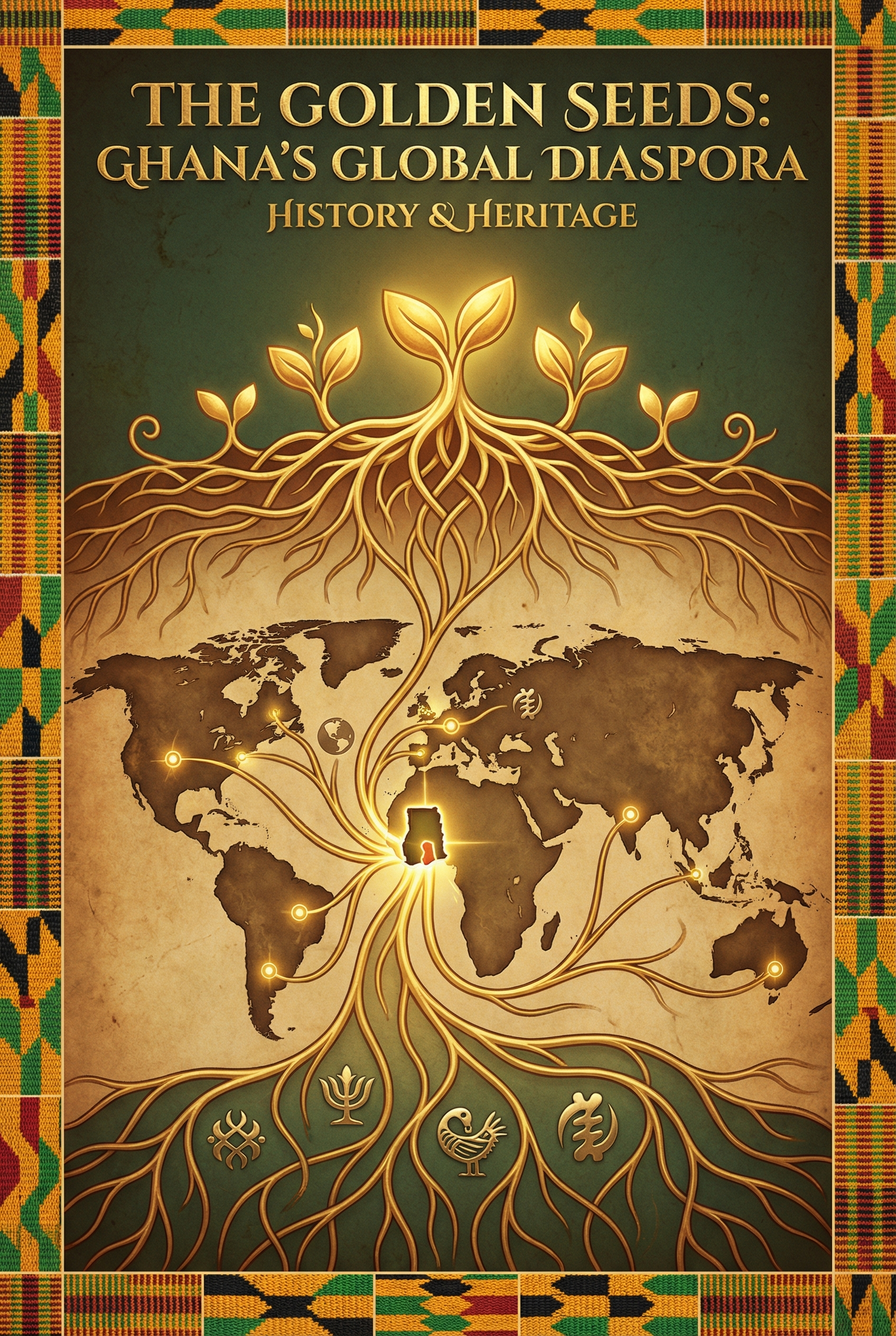
Scattered Seeds, Golden Roots: The Ghanaian Diaspora and the Making of a Transnational Nation (1960-2025)
- diaspora
- migration
- remittances
- identity
- transnational
Chapter 1
The First Wave: Students, Scholars, and the Dream of Return (1890-1966)
The story of Ghanaians abroad begins not in the 1960s but in the late nineteenth century, when a small elite of Gold Coast families sent their sons to Britain for education. J.E. Casely Hayford studied law at Cambridge and Lincoln's Inn in the 1890s, returning to found the National Congress of British West Africa in 1920. J.B. Danquah earned a PhD in philosophy from the University of London in 1927, becoming the first West African to hold a British doctoral degree. Kwame Nkrumah's journey was more circuitous: arriving at Lincoln University, Pennsylvania in 1935, he spent a decade in America, earning a BA (1939), a Sacred Theology degree (1942), and master's degrees from the University of Pennsylvania, before moving to the London School of Economics in 1945. At the Fifth Pan-African Congress in Manchester (15-21 October 1945), Nkrumah joined George Padmore, Jomo Kenyatta, and W.E.B. Du Bois in demanding an end to colonial rule. This congress catalysed the independence generation. The Gold Coast student community in 1950s London numbered approximately 2,000, centred around the West African Students' Union (WASU) hostel at 1 South Villas, Camden Town, founded by Ladipo Solanke in 1925. WASU produced future heads of state and cabinet ministers across West Africa. After independence on 6 March 1957, Nkrumah's government offered scholarships abroad — between 1957 and 1966, an estimated 5,000 Ghanaians studied in Britain, the Soviet Union, and the United States. Many returned to staff the new civil service, universities (University of Ghana, Legon, chartered 1961; KNUST, 1961), and diplomatic missions. The concept of "been-to" — a Ghanaian who had been to Europe — carried enormous social prestige. But Nkrumah's overthrow on 24 February 1966 created the first political exiles, including the president himself, who died in Bucharest on 27 April 1972.
About This Book
"Scattered Seeds, Golden Roots" charts the complex and multifaceted story of the Ghanaian diaspora from the post-independence era to the present day, examining its profound impact on both Ghana and the global landscape. The book moves beyond simple narratives of migration to explore the intricate interplay between homeland and diasporic communities, highlighting how Ghanaians abroad have actively shaped national identity, economic development, and political discourse. The narrative begins in the 1960s, tracing the experiences of the first wave of Ghanaian students who ventured to the United Kingdom and North America for higher education. These early pioneers faced challenges of racial discrimination and cultural adjustment, but also forged vibrant communities and laid the groundwork for future generations. The book details how these early migrants became crucial conduits of knowledge, capital, and ideas, contributing significantly to Ghana's development after independence. Key figures such as Dr. Alexander Kwapong, the first Ghanaian Vice-Chancellor of the University of Ghana, and his efforts to foster academic links with overseas institutions, are explored. The book then examines the expansion of the diaspora in the 1970s and 80s, driven by economic hardship and political instability in Ghana. This period saw a shift in migration patterns, with Ghanaians seeking opportunities in Europe, the Americas, and even other parts of Africa. The emergence of Ghanaian churches and ethnic associations abroad, offering vital social and cultural support to migrants, are analyzed as crucial elements of diasporic identity formation. The book also explores the controversial "Ghana Must Go" expulsion of Ghanaians from Nigeria in 1983 and its long-term ramifications. In the late 20th and early 21st centuries, the Ghanaian diaspora has become increasingly diverse and influential. The book delves into the role of remittances in the Ghanaian economy, the rise of diasporic entrepreneurs investing in Ghana, and the increasing engagement of Ghanaians abroad in national politics. Specific examples like the advocacy efforts of diasporic groups for dual citizenship and voting rights are investigated. Ultimately, "Scattered Seeds, Golden Roots" provides a nuanced and compelling account of the Ghanaian diaspora's transformative impact on both Ghana and the world, revealing the continuous creation of a transnational nation.
About the Author
The study of the Ghanaian diaspora has evolved significantly since the immediate post-independence period. Early scholarship often focused on the "brain drain" and its negative consequences for Ghana's development. Figures such as Professor Kofi Awoonor, though primarily a poet and diplomat, wrote extensively about the challenges facing Ghana and its educated citizens abroad, reflecting the anxieties of the time. Later, scholars like Takyiwaa Manuh and Paul Nugent broadened the scope of inquiry, examining the social, cultural, and economic contributions of Ghanaians abroad. Manuh's work, in particular, emphasized the agency of diasporic women and their roles in maintaining transnational links. More recently, a new generation of researchers have embraced interdisciplinary approaches, drawing on anthropology, sociology, and political science to understand the complexities of diasporic identity, remittances, and political participation. These works build on oral histories, archival research, and ethnographic studies to create a vibrant and growing field of knowledge.
Key Themes
- Transnationalism
- Diaspora Identity
- Remittances and Development
- Political Participation
- Cultural Preservation
- Migration and Mobility
Why This Matters
The story of the Ghanaian diaspora is crucial for understanding Ghana's modern development and its place in the world. It reveals how migration, often driven by hardship, can also be a source of innovation, resilience, and transnational connection. Recognizing the diaspora's contributions challenges simplistic narratives of "brain drain" and highlights the complex ways in which Ghanaians abroad actively shape their homeland.
This history is especially relevant for diaspora members seeking to connect with their heritage and understand their families' journeys. It provides context for the challenges and triumphs of past generations and inspires a sense of shared identity and responsibility. Students, in particular, will find valuable insights into the dynamics of globalization, the complexities of transnationalism, and the ongoing processes of identity formation in a rapidly changing world. Understanding this history empowers both homeland and diasporic communities to build stronger, more equitable relationships.
Historical and Cultural Context
The Ghanaian diaspora's story is intertwined with broader histories of African migration, colonialism, and Pan-Africanism. The legacies of colonialism, including unequal economic structures and political instability, fueled migration from Ghana. Furthermore, the Pan-African movement, with its emphasis on unity and solidarity among people of African descent, has deeply influenced diasporic identity and political engagement. Within the Sankofa Library, this book connects to collections on Kwame Nkrumah's foreign policy, which fostered connections with Africans in the diaspora, and narratives of return migration to Ghana, highlighting the ongoing dialogue between homeland and diaspora.


