
Keyboard shortcuts
- J: Next chapter
- K: Previous chapter
- T: Toggle table of contents
- Shift+S: Share book
- +: Increase font size
- -: Decrease font size
- Escape: Close modals
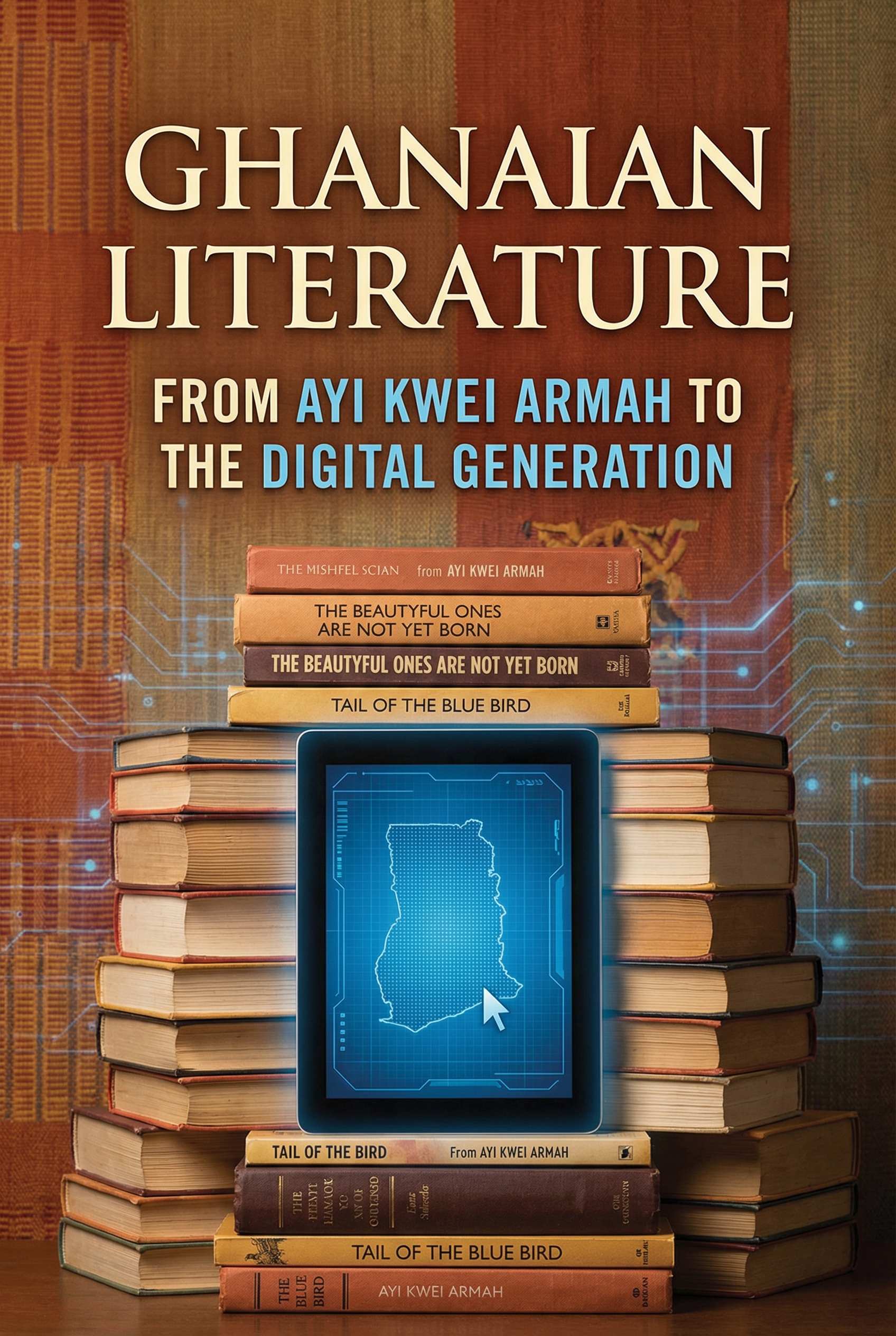
Words That Burn and Heal: Ghanaian Literature from Ayi Kwei Armah to the Digital Generation
↓Chapter 1
Part 1
## The Soil From Which Ghanaian Literature Grew
Literature did not arrive in Ghana with colonialism. Long before European missionaries set up printing presses in the mid-nineteenth century, Ghana's peoples possessed rich oral traditions. The griots of the north whose oral histories stretched back centuries, the Akan storytellers who wove moral philosophy into Anansi spider tales, the linguists (okyeame) of the royal courts whose mastery of language was an art form in itself. When the Basel and Wesleyan missions established the first printing presses on the Gold Coast in the 1850s and 1860s, they were not introducing literacy to a blank slate but superimposing an alphabetic technology onto a culture that already understood the power of words.
The first generation of Gold Coast writers used the printed word with unmistakable political intent. Casely Hayford's Ethiopia Unbound (1911), widely considered the first African novel in English, was published by the same Joseph Ephraim Casely Hayford who co-founded the National Congress of British West Africa and argued, decades before Nkrumah, for a pan-African political federation. Hayford understood that the novel was a political instrument: a form that could carry arguments for African dignity and self-governance in the language of the colonizer, reach educated audiences in London as well as Lagos, and demonstrate by its very existence that African intellectual sophistication was not a product of European tutelage.
J.B. Danquah, whose political career would make him Nkrumah's great rival and the colonial government's political prisoner, was also a playwright and essayist of distinction. His Akan Doctrine of God (1944) exemplified the project that animated Gold Coast intellectuals throughout the colonial period: recovering, systematizing, and defending African philosophical and cultural traditions against the condescension of colonial educators who insisted that Africa had no philosophy worth studying.
## Ayi Kwei Armah: The Great Indictment
No Ghanaian writer has been more studied, more argued over, or more influential than Ayi Kwei Armah, born in Takoradi in 1939. His debut novel, The Beautyful Ones Are Not Yet Born, published in 1968, just eleven years after independence, announced a literary voice of devastating power and moral seriousness.
The novel is set in the Nkrumah years and their immediate aftermath, told from the perspective of a railway clerk known only as 'the man', an everyman figure of painful integrity in a society where corruption has become the universal currency of survival. Armah's Ghana is rendered in an almost hallucinatory prose that makes the physical world itself seem to rot. The stench is not incidental. It is Armah's central metaphor: a society that has betrayed its independence, embraced the corruption of the departed colonizers, and lost the moral clarity that the independence struggle had promised.
The novel's title, deliberately misspelled, comes from a political slogan painted on a bus in the novel's final pages. The beautyful ones are not yet born: the just, the uncorrupted, the truly free people will come, but they are not here yet. It was a message that landed like a slap across the face of a Ghana that had just watched Nkrumah's government toppled by a military coup, a Ghana wondering whether independence had been a liberation or merely a transfer of power from white hands to black ones.
About This Book
"Words That Burn and Heal: Ghanaian Literature from Ayi Kwei Armah to the Digital Generation" delves into the vibrant and often turbulent history of Ghanaian literary expression from the early 20th century to the present day. The book begins by examining the roots of modern Ghanaian literature in the colonial era, exploring the works of early nationalist writers like Kobina Sekyi, whose satirical plays critiqued colonial hypocrisy and advocated for cultural self-determination. It then moves to the post-independence period, focusing on the disillusionment and political instability that characterized Ghana under Kwame Nkrumah and subsequent regimes. Ayi Kwei Armah's "The Beautyful Ones Are Not Yet Born" becomes a central text for understanding this era, its unflinching portrayal of corruption and moral decay casting a long shadow over Ghanaian literature. The book also highlights the contributions of female writers such as Ama Ata Aidoo, whose feminist perspectives challenged patriarchal norms and explored the complexities of African womanhood. Aidoo's plays and novels, along with those of Efua Sutherland, provided crucial counter-narratives to dominant representations of women in Ghanaian society. Furthermore, the book examines the development of Ghanaian literature in the diaspora, tracing the impact of writers like Yaa Gyasi and Taiye Selasi, whose works grapple with themes of identity, migration, and the legacies of colonialism in a global context. In addition, it surveys the rise of spoken word, performance poetry, and digital literary forms, reflecting the evolving landscape of Ghanaian creative expression in the 21st century. Finally, it analyzes how Ghanaian writers have engaged with Pan-Africanism, neo-colonialism, and the ongoing struggle for social justice, showing how literary art continues to be a powerful force for change.
About the Author
The study of Ghanaian literature draws upon a rich tradition of scholarship both within Ghana and internationally. Scholars like Abena P.A. Busia, Stephanie Newell, Ato Quayson, and Kwame Anthony Appiah have been instrumental in shaping the field. Their work builds upon the foundations laid by early critics and literary historians at the University of Ghana, Legon, and the University of Cape Coast, who were crucial in establishing the canon of Ghanaian literature and promoting its study. The scholarship is also indebted to the work of oral historians and cultural researchers who have preserved and documented traditional Akan storytelling, Ewe oral poetry, and other forms of indigenous literary expression that predate the written word. This book synthesizes and builds on this existing body of knowledge, incorporating insights from postcolonial theory, feminist criticism, and cultural studies to provide a nuanced and comprehensive analysis of Ghanaian literature.
Key Themes
- Postcolonial disillusionment
- Feminist perspectives
- Corruption and governance
- Diasporic identity
- Cultural nationalism
- Neo-colonialism
- Oral tradition and literature
Why This Matters
Ghanaian literature offers invaluable insights into the nation's history, culture, and social dynamics. It serves as a powerful lens through which to examine the complexities of colonialism, independence, and globalization, revealing the struggles and triumphs of the Ghanaian people in their quest for self-determination. For the diaspora, Ghanaian literature provides a vital connection to their ancestral homeland, offering a deeper understanding of their cultural heritage and fostering a sense of belonging. Students can learn from the ethical and political debates conducted through literature and discover how creativity can challenge and change the world. By engaging with these stories, readers can gain a greater appreciation for the rich tapestry of Ghanaian society and its ongoing contributions to African and global culture.
Historical and Cultural Context
Ghanaian literature exists within a broader context of West African and African literature. It shares common themes and concerns with the works of Nigerian writers such as Chinua Achebe and Wole Soyinka, as well as Senegalese writers like Léopold Sédar Senghor. All these literatures grapple with the legacies of colonialism, the challenges of nation-building, and the search for cultural identity. Within the Sankofa Digital Heritage Library, this book can be read in conjunction with texts on Ghanaian history, politics, and culture, as well as with works by other African writers and scholars. This interdisciplinary approach allows for a more comprehensive and nuanced understanding of Ghana's place in the African and global landscape.