
Keyboard shortcuts
- J: Next chapter
- K: Previous chapter
- T: Toggle table of contents
- Shift+S: Share book
- +: Increase font size
- -: Decrease font size
- Escape: Close modals
Chapter 1
Part 1
## Founding Visions: Ghana and the Birth of ECOWAS (1975)
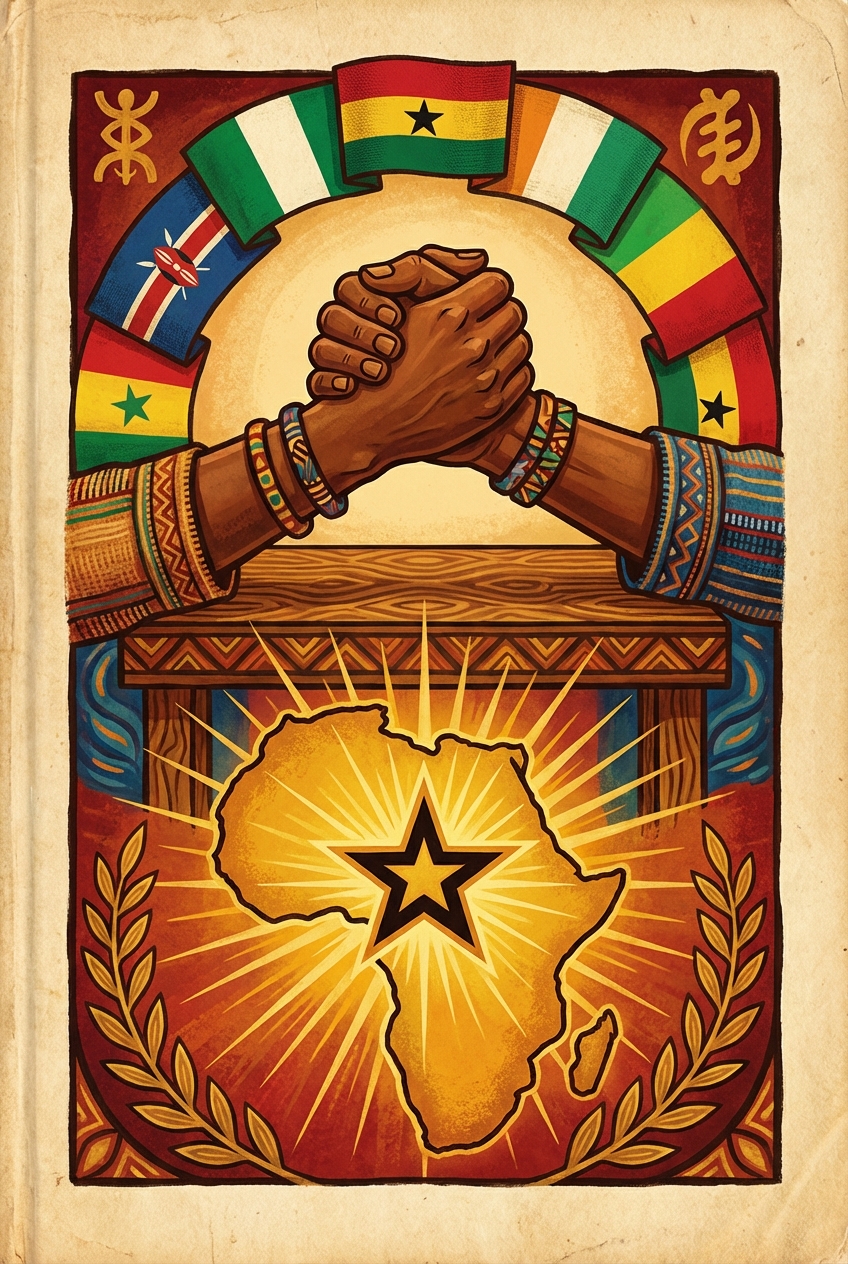
On May 28, 1975, in Lagos, Nigeria, fifteen West African heads of state signed the Treaty of Lagos, bringing the Economic Community of West African States (ECOWAS) into existence. Among those fifteen nations was Ghana, then under the military rule of General Ignatius Kutu Acheampong. Despite the irony of a non-democratic government joining a community that would later champion democratic norms, Ghana's membership from day one reflected its deep-seated commitment to West African solidarity — a commitment rooted in the Pan-Africanist philosophy of Kwame Nkrumah.
Nkrumah had famously declared in 1963: 'We must unite now or perish.' Though he was overthrown before ECOWAS was founded, his ideological fingerprints were unmistakable on the enterprise. Ghana's founding membership was therefore not merely a political act but a philosophical one — a continuation of the Nkrumahist vision of a united, economically integrated Africa beginning with its western region. The original treaty focused on eliminating trade barriers, establishing a customs union, and building the institutional infrastructure for economic cooperation among nations that shared colonial borders but little organic economic connectivity.
In the early years, Ghana's contribution was largely through institutional participation and the intellectual capital of its diplomats and technocrats. Ghanaian officials helped shape ECOWAS's early protocols, particularly around the movement of persons. The 1979 Protocol on Free Movement of Persons, Right of Residence and Establishment was a landmark achievement that bore Ghana's strong advocacy fingerprint, as Accra sought to normalize intra-regional mobility for its traders, workers, and diaspora communities.
## The ECOMOG Era: Ghana's Military Diplomacy in Liberia and Sierra Leone
The defining chapter of Ghana's relationship with ECOWAS arrived not in a conference room but on the battlefields of Liberia. When civil war erupted in Liberia in 1989 under the warlord Charles Taylor, ECOWAS convened an emergency summit and established the ECOWAS Monitoring Group — ECOMOG — in August 1990. Ghana was among the first and most committed contributors, deploying thousands of troops to the peacekeeping mission that would last until 1999.
Ghanaian soldiers served under ECOMOG's multinational command alongside troops from Nigeria, Guinea, Sierra Leone, and Gambia. The Ghanaian contingent distinguished itself through professionalism and restraint, operating in some of the most brutal urban warfare environments seen in post-colonial Africa. Cities like Monrovia were reduced to rubble by factional fighting, yet Ghanaian peacekeepers provided critical protective corridors for civilian evacuations, humanitarian aid delivery, and the creation of demilitarized zones around key infrastructure.
About This Book
"Ghana's Role in ECOWAS: Diplomacy, Peace, and Regional Integration in West Africa" delves into Ghana's complex and multifaceted involvement in the Economic Community of West African States (ECOWAS) from its inception in 1975 to the present day. The book meticulously charts Ghana's contributions as a founding member, spearheaded by Head of State General Ignatius Kutu Acheampong, who envisioned ECOWAS as a crucial vehicle for regional self-reliance and economic development, moving away from neo-colonial dependencies. It examines the shifting dynamics of Ghana's commitment to ECOWAS across different political regimes, from the revolutionary zeal of Jerry John Rawlings' Provisional National Defence Council (PNDC), which initially prioritized national self-sufficiency before embracing regional integration, to the democratic era under presidents like Jerry John Rawlings (again, democratically elected), John Agyekum Kufuor, and John Dramani Mahama, who championed ECOWAS initiatives on free trade, infrastructure development, and political stability. The book scrutinizes Ghana's active participation in ECOWAS peacekeeping missions, notably its leadership role in ECOMOG interventions in Liberia and Sierra Leone, highlighting the sacrifices made by Ghanaian soldiers and the challenges of maintaining peace in conflict-ridden zones. Furthermore, the book assesses Ghana's role as a mediator in regional disputes, analyzing its diplomatic efforts to resolve conflicts in countries like Togo and Côte d'Ivoire. It explores Ghana's commitment to democratic governance within ECOWAS, positioning itself as a model for other West African nations by holding regular elections and promoting the rule of law. Moreover, it analyzes the economic implications of ECOWAS membership for Ghana, evaluating the benefits and challenges of trade liberalization, regional infrastructure projects, and the free movement of people. Finally, the book provides a critical assessment of ECOWAS's achievements and shortcomings, considering the persistent challenges of implementation, funding, and political will. Readers will gain an understanding of Ghana's diplomatic strategies, its contributions to regional security, and its aspirations for a more integrated and prosperous West Africa.
About the Author
The study of Ghana's role in ECOWAS builds upon a rich tradition of scholarship examining Pan-Africanism and regional integration in Africa. Scholars like Dr. Adebayo Adedeji, the former Executive Secretary of the UN Economic Commission for Africa, have extensively documented the historical context of regional cooperation efforts on the continent. Works by Professor Ali Mazrui explore the broader themes of African unity and development, providing a valuable framework for understanding Ghana's engagement with ECOWAS. Ghanaian academics such as Professor Esi Sutherland-Addy have contributed significantly to understanding the cultural dimensions of regional integration, while historians like Professor Emmanuel Akyeampong offer perspectives on Ghana's post-colonial identity and its role in shaping regional dynamics. This book draws upon and contributes to this ongoing scholarly conversation, providing a contemporary analysis of Ghana's commitment to ECOWAS.
Key Themes
- Regional Integration
- Peacekeeping
- Diplomacy
- Economic Development
- Democratic Governance
- Pan-Africanism
Why This Matters
Ghana's involvement in ECOWAS provides a crucial lens for understanding the complexities of African regionalism and its impact on the continent's development. This topic matters because it illuminates Ghana's agency in shaping its own destiny and contributing to the collective well-being of West Africa. For the diaspora, it highlights the ongoing efforts to build a stronger, more unified Africa, offering a counter-narrative to the often-negative portrayals of the continent. Students can learn about the challenges and opportunities of regional integration, the importance of diplomacy and conflict resolution, and the role of leadership in fostering cooperation. Understanding Ghana's commitment to ECOWAS is essential for appreciating the country's place in African history and its aspirations for a more prosperous future.
Historical and Cultural Context
Ghana's participation in ECOWAS is deeply rooted in the Pan-African ideals championed by Kwame Nkrumah, who envisioned a united Africa capable of competing on the global stage. Nkrumah's advocacy for continental unity laid the groundwork for subsequent regional integration efforts. This book sits within the Sankofa Library alongside other works documenting Ghana's involvement in Pan-African movements, its contributions to the anti-apartheid struggle, and its engagement with other African nations. Understanding Ghana's role in ECOWAS complements these narratives, showcasing the country's ongoing commitment to African solidarity and its efforts to build a more integrated and prosperous continent.