Keyboard shortcuts
- J: Next chapter
- K: Previous chapter
- T: Toggle table of contents
- Shift+S: Share book
- +: Increase font size
- -: Decrease font size
- Escape: Close modals
Nets, Canoes, and Coastal Kinship: The Cape Coast Fishing Communities and Their Enduring Legacy
↓Chapter 1
Part 1
## The Sea as Home: Fishing Identity on the Central Region Coast
Long before Cape Coast became famous for its castles and the weight of the Atlantic slave trade, before Elmina's whitewashed walls reflected in the waters of the Gulf of Guinea, the coastline of Ghana's Central Region was home to communities whose entire existence was organized around the sea. The Fante fishers of Cape Coast, Moree, Anomabo, Saltpond, Apam, and the Ahanta communities further west near Sekondi represent one of West Africa's most ancient and sophisticated maritime traditions — a tradition that has survived five centuries of colonial disruption, the trauma of the slave trade conducted from their own shorelines, and the contemporary pressures of industrial fishing and climate change.
The relationship between these coastal Fante communities and the sea is not purely economic. It is cosmological, spiritual, and deeply woven into the fabric of identity. The sea — called "Bosompo" in Twi and Fante — is not simply a resource to be exploited but an entity to be respected, propitiated, and negotiated with. Fishing communities have always understood this, which is why the rhythms of fishing on the Central Region coast have traditionally been punctuated by ceremonies, taboos, and festivals that acknowledge the sea's power and the fisher's dependence upon it.
## The Canoe Technology: Centuries of Accumulated Knowledge
The dugout canoe — hewn from the trunks of the wawa tree (Triplochiton scleroxylon) or the odum tree (Chlorophora excelsa) — is the technological heart of Ghana's canoe fishing tradition. The craft of canoe building along the Central Region coast represents an extraordinary accumulation of knowledge about wood properties, wave dynamics, hull geometry, and ocean behavior that was developed empirically over many generations. A master canoe builder in Moree or Cape Coast could read the grain of a felled tree and predict how it would respond to carving, curing, and the stresses of deep water.
The canoes of the Central Region coast came in several sizes, each suited to specific fishing conditions. Small canoes (called "aboto" in Fante) were used for lagoon and near-shore fishing, often operated by one or two people. Medium canoes served for day fishing in coastal waters. The large ocean-going canoes — sometimes thirty feet or more in length, requiring eight to twenty paddlers — were the workhorses of the deep-sea fishing economy, capable of venturing miles offshore in search of yellowfin tuna, barracuda, snapper, and the enormous catches of sardines and herrings that had sustained coastal populations for centuries.
The construction of a large canoe was a community event, not merely an individual craft exercise. The builder's skill was essential, but the ritual dimensions were equally important. Before the first stroke of the adze, libations were poured and prayers offered. When a large canoe was completed, its launching into the sea required ceremony — the canoe was christened, names were carved or painted on the prow, and its inaugural voyage was attended by the prayers and well-wishes of the entire community. The canoe was, in a sense, a community member with its own identity and spiritual standing.
## Moree and Anomabo: The Canoe Fishing Capitals
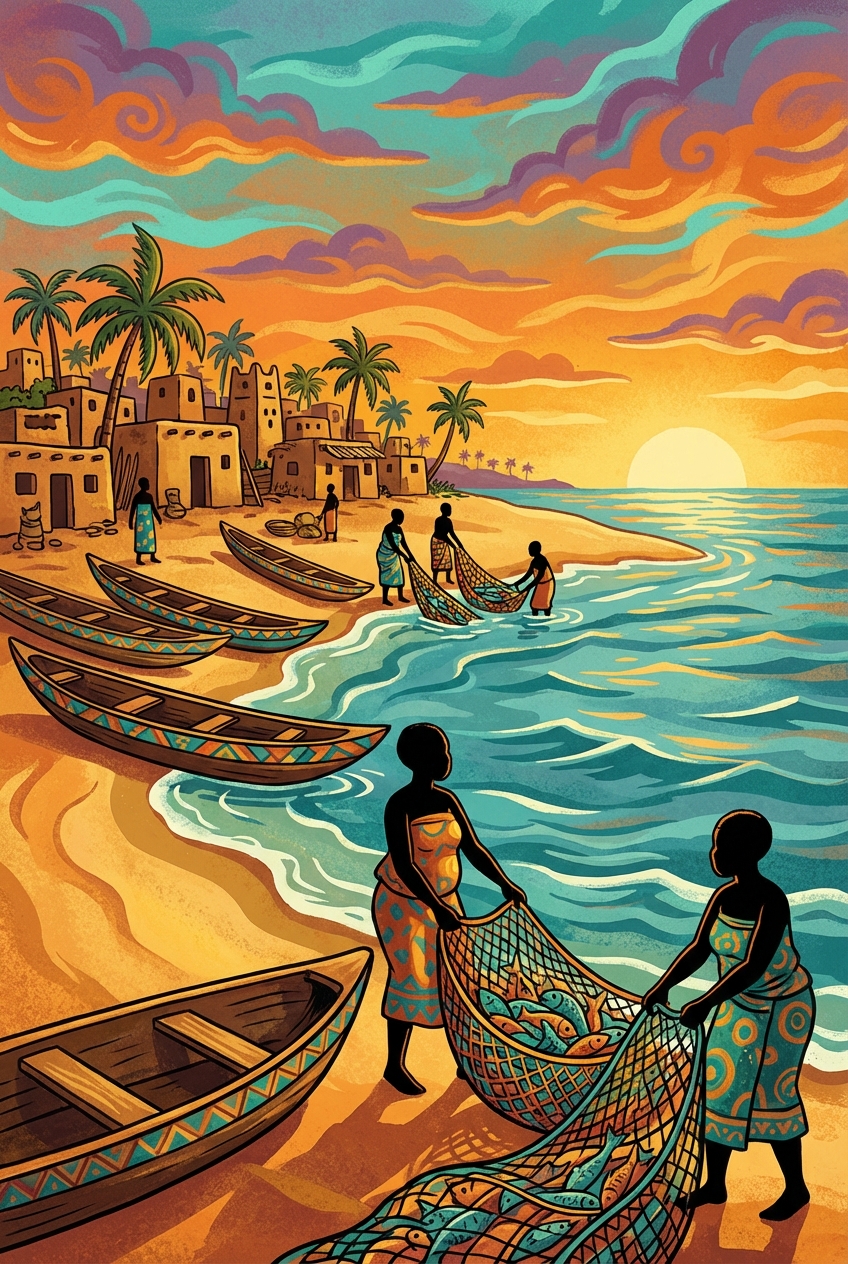
Among the fishing communities of the Central Region, two stand out for their historical depth and continuing vitality: Moree and Anomabo. Moree, a small fishing town north of Cape Coast, is widely considered the ancestral home of Ghana's canoe fishing tradition and remains today one of the most active canoe fishing communities in the country. The beach at Moree is a visual encyclopedia of the fishing life: dozens of brightly painted canoes drawn up above the tide line, nets spread to dry in the sun, women sorting and smoking fish in large clay ovens, and the constant activity of preparation, departure, and return that defines a fishing community's daily rhythm.
About This Book
"Nets, Canoes, and Coastal Kinship" offers an intimate portrait of the Fante fishing communities along the Cape Coast, delving into their social, economic, and spiritual lives from the 15th century to the present day. It traces the origins of the Fante canoe fishing tradition, analyzing the construction techniques, navigation skills, and ritual practices associated with these vital vessels. The book examines the pivotal role of women in the fishing economy, particularly their dominance in the sardinella trade centered in Elmina. It highlights the unique matrilineal social structures that govern land ownership, inheritance, and political power within these communities, providing a counterpoint to more commonly studied patrilineal Akan societies. The book also meticulously details the impact of the transatlantic slave trade and subsequent colonial rule on these fishing communities. It explores how the demand for enslaved people disrupted traditional labor patterns, intensified inter-community conflict, and led to the exploitation of coastal resources by European powers. It analyzes the ways in which local fishing communities resisted colonial encroachment through subtle acts of defiance and strategic alliances with inland Akan states. The impact of 20th-century development policies -- particularly the introduction of industrial fishing fleets -- is examined, highlighting the challenges faced by traditional fishers in the face of dwindling fish stocks and environmental degradation. "Nets, Canoes, and Coastal Kinship" culminates in a reflection on the enduring resilience of Fante fishing communities in the face of ongoing social, economic, and environmental pressures. It emphasizes the importance of preserving traditional knowledge, promoting sustainable fishing practices, and strengthening local governance structures to ensure the long-term well-being of these vital coastal societies. Readers will gain a deep appreciation for the complex history, cultural richness, and ecological significance of the Cape Coast fishing communities.
About the Author
The study of Ghanaian coastal communities draws upon a rich tradition of scholarship. Early ethnographic accounts, often produced by colonial administrators and missionaries, provide valuable, though biased, insights into coastal life. Reindorf's "History of the Gold Coast and Asante" offers crucial early perspectives from an African vantage. More recently, scholars such as George P. Hagan, Kwesi Ansu-Kyeremeh, and Deborah Pellow have contributed extensively to our understanding of Fante social organization, economic practices, and religious beliefs. This work relies heavily on oral histories collected from elders and community leaders, alongside archival research in Ghana, Europe, and North America, building upon this legacy of engaged, interdisciplinary inquiry.
Key Themes
- Fante canoe fishing
- Matrilineal kinship
- Sardinella trade
- Colonial disruption
- Coastal livelihoods
- Environmental sustainability
Why This Matters
This exploration of Cape Coast fishing communities provides a crucial counter-narrative to dominant historical accounts that often focus on elite political figures and transatlantic trade. It foregrounds the experiences of ordinary people whose lives have been shaped by both the opportunities and challenges of coastal existence. Understanding the resilience of these communities -- their adaptation to changing environmental conditions, their resistance to colonial exploitation, and their innovative strategies for economic survival -- is essential for appreciating the richness and complexity of Ghanaian and African heritage. For the diaspora and students, this story offers a connection to ancestral lands, a deeper understanding of Akan cultural values, and a model for sustainable community development. It underscores the importance of preserving traditional knowledge and empowering local communities in the face of global challenges.
Historical and Cultural Context
The story of Cape Coast fishing communities resonates with broader themes in African history. The matrilineal social organization found among the Fante, for example, connects them to other matrilineal societies across West Africa and beyond. Their engagement with the transatlantic trade mirrors the experiences of coastal communities throughout the continent, highlighting both the devastating consequences of the slave trade and the agency of Africans in shaping their interactions with European powers. In the Sankofa Library, this study complements works on Akan statecraft, colonial resistance movements, and the history of trade networks in West Africa.