Keyboard shortcuts
- J: Next chapter
- K: Previous chapter
- T: Toggle table of contents
- Shift+S: Share book
- +: Increase font size
- -: Decrease font size
- Escape: Close modals
Chapter 1
Part 1
When European colonial administrators first arrived on the Gold Coast, they encountered a political system they fundamentally misunderstood. Operating under strict Victorian assumptions about gender and power, the British sought out the "kings" to negotiate treaties, sign trade agreements, and assert control. They assumed that the women who sat beside the chiefs in the royal courts were merely wives, decorative figures with no real constitutional authority. This fatal misunderstanding of the Akan political structure would eventually lead to the greatest military humiliation the British Empire ever suffered in West Africa.
The women the British ignored were not wives. They were the ohemaa, the Queen Mothers. In the matrilineal societies of the Akan people, which include the Ashanti, Fante, and Akyem, power is not a solitary patriarchal enterprise. It is a dual monarchy, carefully balanced between male and female authority. The Queen Mother is the co-ruler, the genealogist of the royal lineage, the principal advisor to the chief, and the ultimate kingmaker. This narrative explores the deep historical roots of the Queen Mother tradition, unpacking the complex judicial, spiritual, and political roles these women have played for centuries. It examines their systemic marginalization during the colonial era and their ongoing fight for formal constitutional recognition in the modern Republic of Ghana.
## Understanding the Dual Monarchy
To comprehend the power of the ohemaa, one must first understand the fundamental organizing principle of Akan society: the matrilineage (the *abusua*). The Akan believe that a person inherits their spirit (*ntoro*) from their father, but their blood (*mogya*) from their mother. Therefore, family identity, clan affiliation, property rights, and, crucially, royal succession are passed exclusively through the female line. A king does not pass the throne to his son. The throne passes to his brother, or to his sister's son. The women are the source of the royal blood.
Within this framework, every town, village, and paramountcy has a dual leadership structure. The male ruler, the *ohene* (chief), represents the executive and military authority of the state. The female ruler, the *ohemaa* (Queen Mother), represents the moral, spiritual, and genealogical authority. She is not the wife of the chief. She is usually his mother, sister, aunt, or cousin. The relationship is political and structural, designed to ensure that neither gender holds absolute, unchecked power over the community.
The selection of a new chief provides the clearest demonstration of her constitutional power. When a stool becomes vacant, it is the sole customary prerogative of the Queen Mother to nominate a candidate. She consults with the senior women of the royal clan, evaluates the character, lineage, and physical suitability of the eligible men, and presents her choice to the kingmakers (the *Gyaase* council). If the council rejects her nominee three consecutive times, only then does the selection process pass out of her hands. The ohemaa is, quite literally, the maker of kings.
About This Book
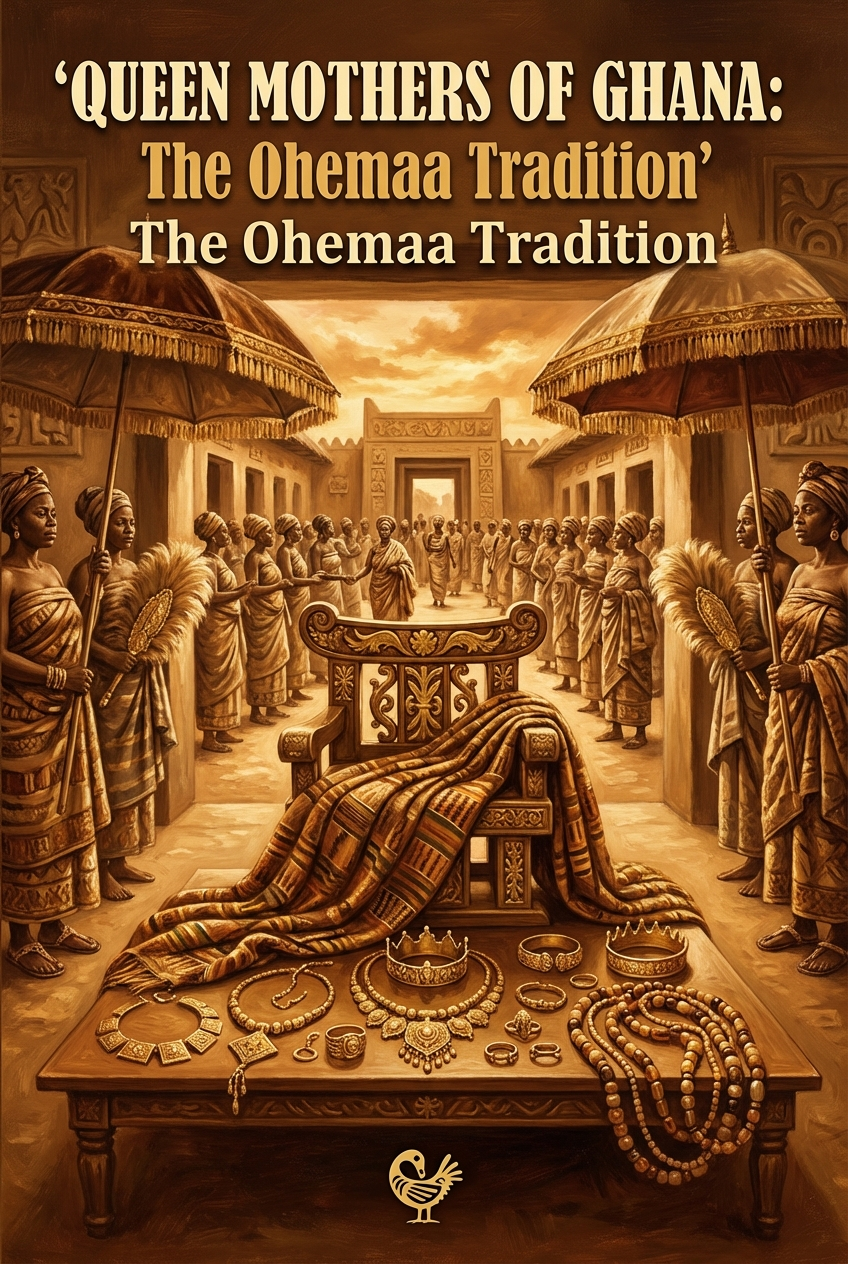
"Queen Mothers of Ghana: The Ohemaa Tradition" delves into the intricate and often misunderstood role of the Ohemaa, or Queen Mother, within Akan society -- a pillar of governance from the pre-colonial period to the present day. This book argues that the Ohemaa is not merely a figurehead or a biological relation to the chief, but a central actor in the political and spiritual landscape of the Akan people. It traces the evolution of the Ohemaa institution, examining its roots in the matrilineal social structure that defines Akan kinship and inheritance. The narrative explores the Ohemaa’s multifaceted responsibilities: maintaining genealogical records (the Akyiakyire), nominating candidates for chieftaincy, advising the chief on matters of state, and even possessing the power to destool a chief deemed unfit to rule. Crucially, the book highlights the Ohemaa's control over land allocation through her lineage, underscoring her economic power. Specific examples from Asante history are investigated, such as Nana Yaa Asantewaa, the Ohemaa of Ejisu, whose leadership in the Anglo-Asante wars exemplifies the Ohemaa's capacity for decisive action and resistance against colonial encroachment. The book also examines the roles of lesser-known but equally influential Ohemaa figures throughout Akan history, illustrating the variations and nuances of the Ohemaa’s position across different Akan states. Furthermore, the study addresses contemporary challenges facing the Ohemaa institution, including the encroachment of Western-style governance and the struggles to maintain traditional authority in a rapidly changing world. It assesses the Ohemaa’s continuing relevance in Ghanaian politics, particularly in local governance and customary law, demonstrating that the Ohemaa's power continues to shape the socio-political landscape of Ghana in the 21st century. Readers will gain a deep understanding of the Akan dual-gender political system, the complexities of matrilineal inheritance, and the enduring legacy of the Ohemaa as a guardian of Akan tradition and a powerful political force.
About the Author
The understanding of the Ohemaa tradition draws from generations of oral history passed down through Akan royal families and communities. This knowledge has been supplemented by the work of early ethnographers like R.S. Rattray, whose "Ashanti" (1923) provided some of the earliest documented insights into Akan social structures. Later scholars, such as Niara Sudarkasa, author of "Where Women Work: A Study of Yoruba Women in the Marketplace and in the Home", have illuminated the economic roles of women in West African societies, providing a framework for understanding the Ohemaa's economic power. More recent Ghanaian scholars, including Takyiwaa Manuh and Agnes Aidoo, have further explored the complexities of Akan gender roles and the evolving role of women in Ghanaian politics, enriching the academic understanding of the Ohemaa's position. This book builds upon their research, weaving together historical accounts, anthropological studies, and contemporary perspectives to offer a comprehensive portrayal of the Ohemaa tradition.
Key Themes
- Matrilineal inheritance
- Akan chieftaincy
- Gender and power
- Pre-colonial governance
- Oral tradition
- Colonial resistance
Why This Matters
Understanding the Ohemaa tradition is essential for grasping the complexities of Ghanaian and African heritage. It reveals a sophisticated system of governance that predates colonialism, highlighting the agency and power wielded by women in pre-colonial African societies. The Ohemaa tradition challenges Western-centric narratives about gender roles and political leadership, offering a powerful example of a dual-gender political system that valued both male and female contributions.
For the diaspora, this story offers a connection to ancestral roots and a deeper understanding of the social and political structures that shaped Akan society. It counters colonial stereotypes and celebrates the resilience of African traditions. Students, in particular, should engage with this story to broaden their understanding of African history and culture, to critically examine Western biases in academic discourse, and to appreciate the enduring legacy of female leadership in Africa. By studying the Ohemaa tradition, readers can gain valuable insights into the dynamics of power, gender, and tradition in a global context.
Historical and Cultural Context
The Ohemaa tradition exists within a broader context of female leadership and matrilineal systems across Africa. Similar traditions can be found among the Yoruba of Nigeria, with the Iyalode, and in other Akan groups such as the Fante. Understanding these parallel systems highlights the diverse ways African societies organized themselves politically and socially before the arrival of European colonizers. Within the Sankofa Library, this book complements studies on other African kingdoms and political institutions, offering a nuanced and multifaceted view of pre-colonial African governance and challenging simplistic narratives of African history.