
Keyboard shortcuts
- J: Next chapter
- K: Previous chapter
- T: Toggle table of contents
- Shift+S: Share book
- +: Increase font size
- -: Decrease font size
- Escape: Close modals
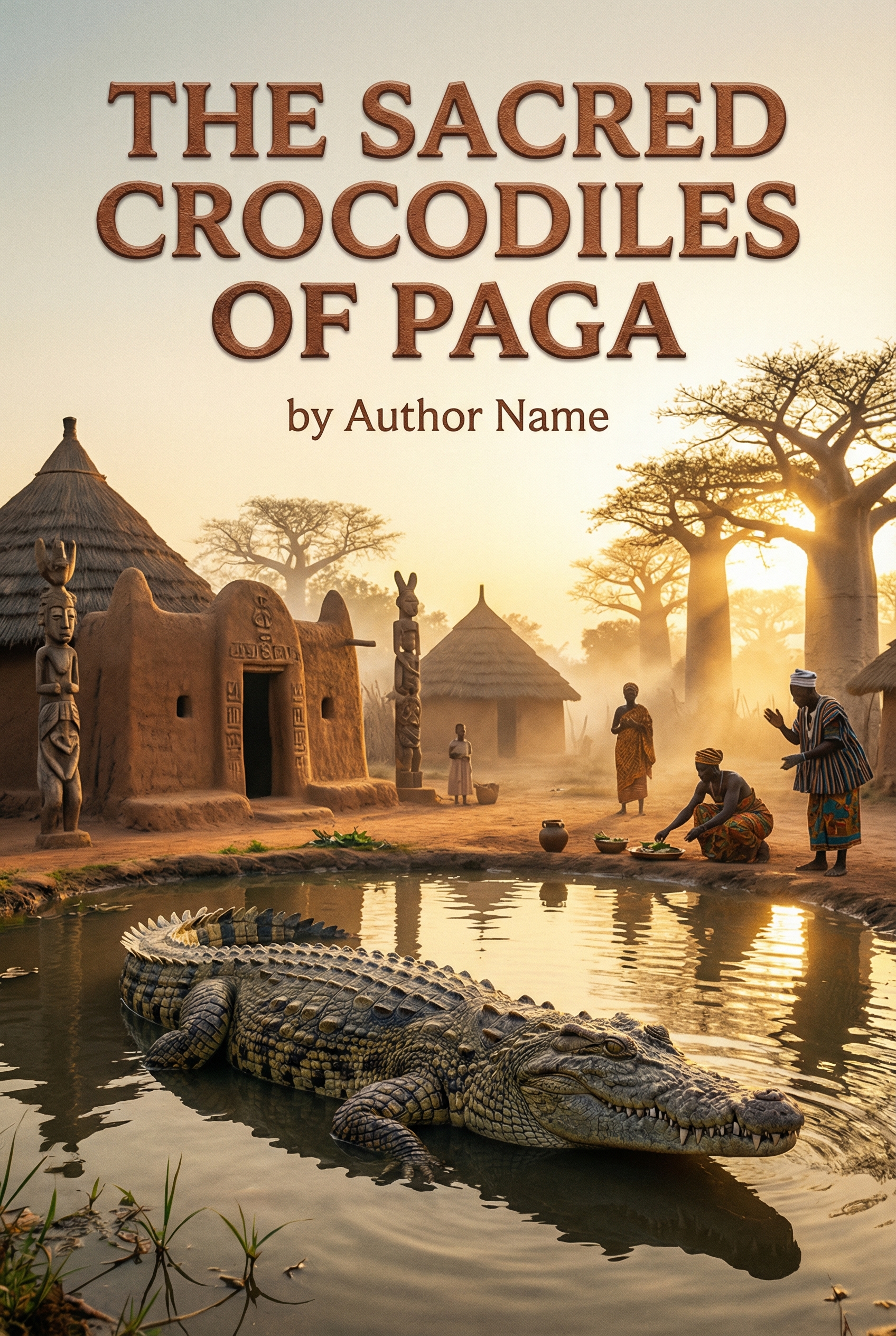
The Sacred Crocodiles of Paga: Spirit Animals, Chieftaincy, and the Sacred-Tourism Economy of Northern Ghana
- Paga
- Sacred Crocodiles
- Kassena People
- Chieftaincy
- Sacred Tourism
- Upper East Region
- Spirit Animals
- Cultural Preservation
- Ghanaian Heritage
- Conservation
Chapter 1
The Genesis of a Sacred Bond: Paga's Crocodiles and the Kassena Soul
### The Genesis of a Sacred Bond: Paga's Crocodiles and the Kassena Soul
Within the sun-drenched landscape of Ghana's Upper East Region, nestled near the border with Burkina Faso, lies the town of Paga. It is here, amidst the vibrant culture of the Kassena people, that a unique and profound relationship between humans and nature has flourished for centuries. This chapter, drawn from the SANKOFA Digital Library's 'The Sacred Crocodiles of Paga: Spirit Animals, Chieftaincy, and the Sacred-Tourism Economy of Northern Ghana,' delves into the genesis of the sacred bond between the Kassena people and the Nile crocodiles (Crocodylus niloticus) that inhabit Paga's ancient ponds, exploring its spiritual, cultural, and socio-economic dimensions.
The cornerstone of this extraordinary relationship is an oral tradition, revered by the Kassena people, that narrates the founding myth of Paga. According to this enduring legend, a young man named Naveh (or Nave), believed to be a direct ancestor of the Kassena, was fleeing from his enemies in ancient times. Exhausted and on the brink of death from thirst, he stumbled upon a pond. A crocodile, sensing his plight, emerged from the water and, through a series of miraculous gestures, guided Naveh to safety and a fresh water source. In gratitude and as a testament to this life-saving intervention, Naveh made a solemn covenant: neither he nor his descendants would ever harm a crocodile, and in return, the crocodiles would remain guardians of the Kassena people. This foundational narrative, passed down through generations, imbues the crocodiles of Paga with an ancestral spiritual significance, elevating them from mere reptiles to sacred totems and spiritual kin.
This sacred bond is deeply interwoven with Kassena traditions and spiritual cosmology. The crocodiles are not merely protected; they are revered as embodiments of ancestral spirits, particularly those of Naveh and his lineage. Their ponds, especially Paga Nania, Paga Zenga, and others scattered across the district (Kassena-Nankana West), are considered sacred sites, repositories of spiritual power and ancestral memory. Unusual crocodile behavior, such as a crocodile venturing far from the pond or the unexplained death of a particularly old specimen, is often interpreted as an omen or a message from the ancestors, requiring specific rituals and consultations with traditional elders. These beliefs foster a profound sense of stewardship, where the well-being of the crocodiles and their habitat is intrinsically linked to the spiritual health and prosperity of the Kassena community.
Chieftaincy plays a pivotal role in the custodianship of this sacred heritage. The Paga Pio (the chief of Paga) is not merely a political leader but also the chief spiritual custodian of the sacred ponds and the traditions surrounding the crocodiles. He, along with a council of elders and designated 'crocodile priests,' is responsible for upholding the covenant, mediating between the human and reptilian worlds, and ensuring the continuity of the rituals and practices that sustain the bond. This traditional authority is instrumental in educating younger generations about the significance of the crocodiles, resolving any potential conflicts, and maintaining the sanctity of the ponds. The unbroken line of chieftaincy ensures that the ancient pact remains a living, breathing aspect of Kassena identity.
In recent decades, Paga's unique human-crocodile interaction has attracted increasing attention, transforming it into a significant site for heritage tourism in Northern Ghana. Visitors are drawn by the opportunity to interact directly with the 'friendly' crocodiles – feeding them chickens, touching their backs, and witnessing a harmonious co-existence that challenges conventional perceptions of these apex predators. This tourism, which gained prominence in the post-independence era and particularly from the late 20th century onwards, has provided significant economic benefits to the local community, creating employment opportunities for tour guides, craft vendors, and hospitality service providers. The Ghana Tourism Authority, alongside local stakeholders, has played a role in promoting Paga as a cultural and ecological destination, often highlighting its proximity to the Paga Slave Camp, another historical site.
However, the intersection of sacred tradition and modern tourism presents both opportunities and challenges. Balancing the sacredness of the crocodiles with the commercial demands of tourism requires careful management. Concerns occasionally arise regarding the potential over-habituation of the crocodiles, the ethical implications of animal interaction, and the impact of increased human presence on their natural behaviors. Conservation efforts, therefore, are critical. While the Kassena people's traditional reverence inherently protects the crocodiles, external pressures like habitat degradation, water pollution, and climate change pose threats. Local initiatives, often supported by NGOs and governmental agencies, focus on maintaining water quality in the ponds, protecting surrounding ecosystems, and ensuring that tourism practices remain sustainable and respectful of both the animals and the cultural traditions. The Nile crocodile, though not globally endangered, benefits immensely from this localized, community-driven conservation strategy.
Beyond its local context, Paga offers a profound case study in indigenous African spirituality and human-animal co-existence, resonating with broader themes in world history and anthropology. It exemplifies how spiritual beliefs can serve as powerful drivers for environmental conservation, a concept often termed 'sacred ecology.' The Paga phenomenon stands as a testament to the intricate relationships that can develop between communities and their natural environment, echoing similar sacred animal traditions found across various cultures, from the revered cows of India to the totemic animals of indigenous Australasian societies. It underscores the enduring relevance of traditional ecological knowledge and practices in fostering sustainable living.
In conclusion, the Genesis of a Sacred Bond in Paga is far more than a charming local legend; it is the bedrock of a complex, living tradition that defines the Kassena people's relationship with their environment. The crocodiles of Paga are not merely animals; they are ancestral guardians, spiritual kin, and a symbol of an enduring covenant. As Paga navigates the complexities of modern tourism and conservation, its story continues to offer invaluable insights into the power of cultural heritage, the resilience of indigenous beliefs, and the possibility of a harmonious co-existence between humanity and the wild, making it a truly invaluable chapter in Ghana's, and indeed the world's, cultural narrative.
About This Book
"The Sacred Crocodiles of Paga" delves into the multifaceted relationship between the people of Paga and their resident Nile crocodiles ( *Crocodylus niloticus*), exploring the origins of this unique bond in ancestral veneration and its evolution into a significant source of economic activity through sacred tourism. The book meticulously traces the history of Paga, a Kassena-Nankana community, and unravels the intricate tapestry of myths, rituals, and taboos surrounding the crocodiles. The narrative pays particular attention to the role of the crocodiles as *tindana* -- the earth priests' -- mediators, interceding between the community and the spiritual realm. It elucidates the belief that these crocodiles embody the spirits of deceased chiefs and elders, thus warranting utmost respect and protection. A key focus is the oral history, preserved and passed down through generations, detailing the origins of the crocodile veneration. These stories often involve tales of crocodiles assisting the ancestors of Paga during times of war or famine, cementing their status as sacred guardians. The book further examines the practical manifestations of this reverence, including the prohibition of harming or consuming the crocodiles, and the performance of specific rituals to appease and honor them. The narrative examines how this traditional reverence has been impacted by modernity, specifically the introduction of tourism in the late 20th century. While tourism has brought economic benefits to Paga, it also presents challenges in balancing the sacred nature of the crocodiles with the demands of a growing industry. The book analyzes the various stakeholders involved -- traditional authorities, tourism operators, and the local community -- and their efforts to manage this delicate balance, ensuring the sustainability of both the crocodile population and the cultural heritage it represents. It also discusses the impact of religious conversion, and how the local people have indigenized their faith with this tradition.
About the Author
The study of sacred groves and animal veneration in Ghana has been a long-standing tradition within both Ghanaian and international scholarship. Early ethnographic work by scholars like R.S. Rattray in the early 20th century provided foundational documentation of Ashanti religious beliefs, which included observations of animal totems and sacred sites. More recent scholars, such as Professor Kwesi Anquandah at the University of Ghana, have built upon this foundation, focusing on the archaeology and cultural significance of sacred spaces across Ghana. Fieldwork-based research by historians, anthropologists, and religious studies specialists contributes to a more nuanced understanding of the complex interplay between traditional belief systems, environmental conservation, and socio-economic development. This book draws upon decades of academic research on Northern Ghanaian history, religion, and economy, as well as the insights and local expertise of Paga community elders and leaders.
Key Themes
- Animal Veneration
- Traditional Religion
- Sacred Tourism
- Cultural Preservation
- Community and Environment
- Kassena-Nankana History
Why This Matters
The story of the Paga crocodiles holds immense significance for understanding Ghanaian and African heritage by illustrating the deep-seated connection between people, their environment, and their spiritual beliefs. It highlights the presence of indigenous African religions and their impact on local and community development. This case study demonstrates how traditional African belief systems can promote environmental conservation and sustainable resource management. For the diaspora, the story of Paga offers a powerful example of the resilience of African cultures and their ability to adapt and thrive in the face of globalization. For students, it provides a fascinating lens through which to examine complex issues such as cultural identity, religious syncretism, and the socio-economic impacts of tourism. The Paga story challenges Eurocentric narratives about Africa, showcasing the sophistication and dynamism of African belief systems and their relevance in the modern world. It underscores the importance of preserving cultural heritage as a valuable resource for sustainable development and community empowerment.
Historical and Cultural Context
The veneration of crocodiles in Paga connects to broader African traditions of animal reverence, found throughout the continent from ancient Egypt's Sobek to various West African water spirit cults. This practice reflects a worldview where the natural and spiritual realms are intertwined, and animals often serve as intermediaries between humans and the divine. Within the Sankofa Library, this narrative can be situated alongside other texts exploring sacred groves, traditional healing practices, and indigenous knowledge systems in Ghana, providing a rich tapestry of African cultural heritage.
Sources & References
- Opoku, E., & Akyeampong, K. (2015). "The Paga Crocodile Pond: An Example of a Community-Based Tourism Initiative in Ghana." Journal of Tourism and Cultural Change, 13(3), 260-276.
- Pobee, J. S. (1991). Traditional Religion and Modernity in Ghana. Wipf and Stock Publishers.
- Anquandah, J. (1982). The Kassena of Northern Ghana: A Socio-Cultural Study. Accra University Press.
- Arhin, K. (2000). Chieftaincy in Ghana: An Overview. Centre for Indigenous Knowledge Systems.