Keyboard shortcuts
- J: Next chapter
- K: Previous chapter
- T: Toggle table of contents
- Shift+S: Share book
- +: Increase font size
- -: Decrease font size
- Escape: Close modals
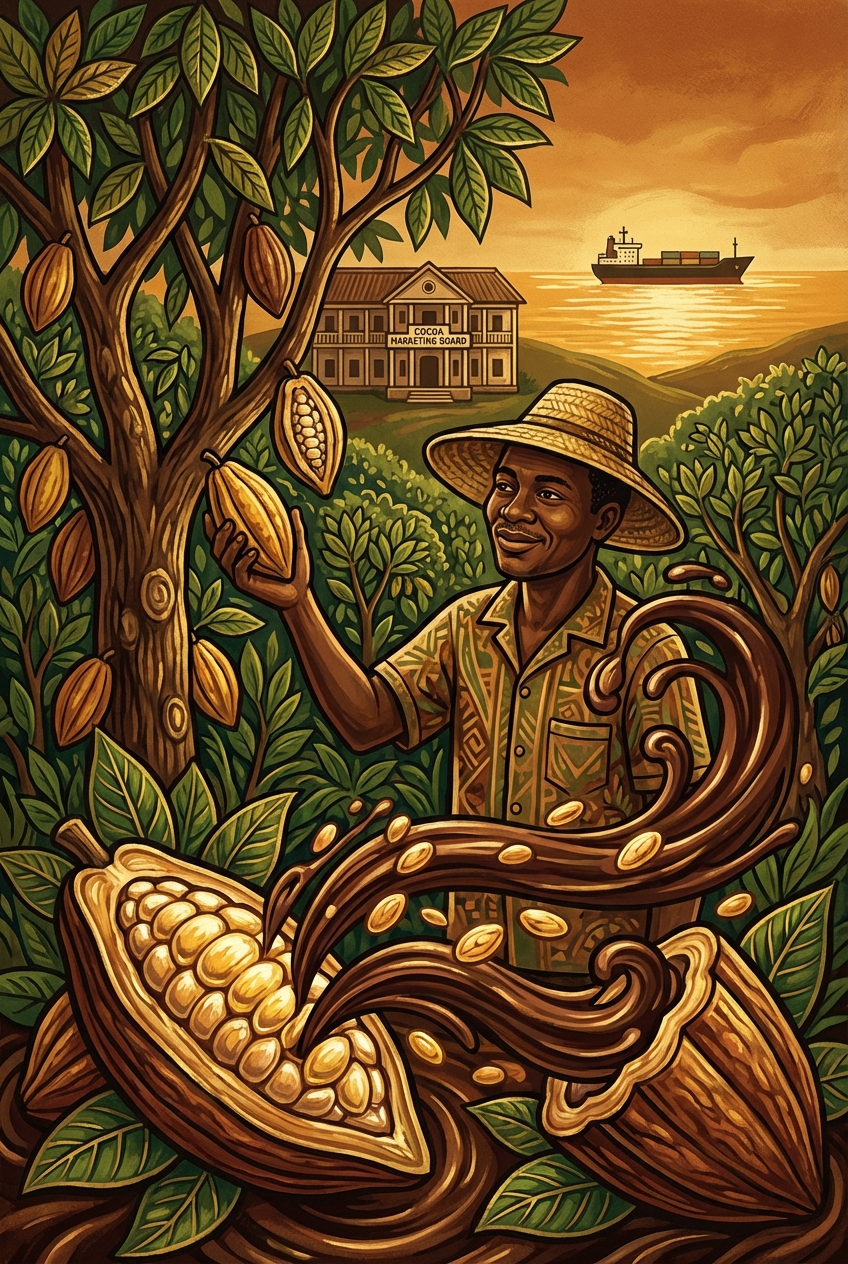
Golden Beans and Board Rooms: COCOBOD, Ghana's Cocoa Marketing Policy, and the Fight to Control the Chocolate Economy
- Cocoa
- COCOBOD
- Ghana
- Kwame Nkrumah
- Agricultural Policy
- Economic History
- Commodity Markets
- Farmers
- Chocolate Industry
- Structural Adjustment
Chapter 1
The Genesis of State Control: From Peasant Power to Marketing Boards
The story of Ghana's cocoa industry begins not with grand government plans, but with the ingenuity of a returning migrant, Tetteh Quarshie, who in 1879 brought cocoa pods from Fernando Po (Bioko) to Mampong-Akuapem. From these humble beginnings, Ghana, then the Gold Coast, rapidly ascended to become the world's leading cocoa producer by the early 20th century, driven by an army of smallholder farmers. However, this burgeoning success also attracted the attention of colonial powers and European merchants, who often dictated prices and terms of trade. The inherent volatility of global commodity markets left farmers vulnerable, leading to widespread discontent. A pivotal moment arrived with the 1937-38 Cocoa Hold-Up, where farmers collectively refused to sell their beans, protesting against low prices and monopolistic practices by European buying firms. This unprecedented act of economic resistance forced the colonial administration to acknowledge the need for greater market regulation. In response, the West African Produce Control Board was established during World War II, evolving into the Ghana Cocoa Marketing Board (CMB) in 1947. This marked the formal inception of state control over cocoa marketing, a move intended to stabilize farmer incomes and protect Ghana's vital economic interest. The establishment of the Cocoa Marketing Board represented a decisive moment in Ghana's quest for economic sovereignty over its most valuable agricultural resource.
About This Book
"Golden Beans and Board Rooms" unveils the intricate story of Ghana's cocoa industry, positioning the Ghana Cocoa Board (COCOBOD) as its central protagonist. The book meticulously traces COCOBOD's origins from the Cocoa Marketing Board (CMB) established in 1947 by the British colonial administration to control cocoa exports and stabilize prices for farmers. It analyzes the motivations behind its creation--primarily to safeguard British economic interests amidst farmer agitation for better prices. We see how the CMB attempted to address issues of price volatility and unfair trading practices that plagued the cocoa sector. Post-independence, the book examines the transformation of the CMB into COCOBOD, a powerful state entity charged with overseeing all aspects of the cocoa industry--from production and research to marketing and export. The book meticulously analyzes COCOBOD's role in implementing various policies, including price stabilization schemes, input subsidies (fertilizers, pesticides), and extension services aimed at improving farmer productivity and incomes. However, it does not shy away from exploring the criticisms leveled against COCOBOD-- accusations of inefficiency, corruption, and its stifling effect on private sector participation in the cocoa trade. It examines the complexities of balancing the interests of smallholder farmers with the demands of the global chocolate market and the pressures from international financial institutions advocating for market liberalization. Key historical events covered include the cocoa holdups of the 1930s (Ahanta-Nzema uprising), the implementation of the Cocoa Production Alliance (COPAL) agreements in the 1960s, and the structural adjustment programs of the 1980s and 1990s that challenged COCOBOD's monopoly. It also considers the rise of the fair trade movement and its impact on cocoa production practices in Ghana. Readers will gain an understanding of the historical debates surrounding cocoa pricing, the challenges faced by Ghanaian farmers in accessing finance and technology, and the ongoing efforts to promote sustainable cocoa production and combat child labor in the industry. The book further investigates COCOBOD’s role in developing and promoting value addition to cocoa, such as the processing of cocoa beans into cocoa liquor and chocolate.
About the Author
The scholarship on Ghana's cocoa industry is rich and diverse, spanning economic history, agricultural studies, and development economics. Pioneering researchers like Polly Hill, whose ethnographic work on cocoa farmers in the Eastern Region provided invaluable insights into their livelihoods and farming practices, laid the groundwork for subsequent studies. More recent scholars, such as Gareth Austin and Stephanie Decker, have focused on the institutional history of COCOBOD and its impact on the broader Ghanaian economy. Their rigorous analyses of COCOBOD's policies and performance have contributed to a deeper understanding of the challenges and opportunities facing Ghana's cocoa sector. Moreover, the work of Ghanaian historians and economists, including Nana Arhin Brempong and Ernest Aryeetey, has been crucial in providing a nuanced perspective on the socio-political dimensions of cocoa production and trade. This book builds upon this tradition of scholarship, drawing on archival sources, oral histories, and contemporary research to offer a comprehensive account of COCOBOD's role in shaping Ghana's cocoa industry.
Key Themes
- State intervention in agriculture
- Cocoa price volatility
- Farmer livelihoods
- Global commodity chains
- Economic development
- Fair trade and sustainability
Why This Matters
The story of COCOBOD and Ghana's cocoa industry is vital for understanding Ghanaian and African heritage for several reasons. It exemplifies the complexities of post-colonial development, revealing the challenges of navigating global markets while attempting to safeguard the interests of local producers. The cocoa industry has been a cornerstone of Ghana's economy for over a century, shaping its social structure, political landscape, and cultural identity.
For the diaspora, this story offers a critical lens through which to examine the legacies of colonialism and the ongoing struggle for economic sovereignty in Africa. Understanding the historical forces that have shaped the cocoa industry can inform contemporary efforts to promote equitable trade relations and support sustainable development in Ghana and other cocoa-producing nations. Students, especially, should engage with this story to gain a deeper appreciation of the challenges and opportunities facing African nations in the global economy, and to develop critical thinking skills necessary to address these complex issues. The COCOBOD narrative is a microcosm for understanding larger economic systems on the continent.
Historical and Cultural Context
The story of COCOBOD is inextricably linked to broader themes in African history, particularly the struggle for economic independence in the post-colonial era. Similar marketing boards were established in other African countries producing commodities like coffee, cotton, and groundnuts, often with mixed results. This book can be contextualized within the Sankofa Library by comparing COCOBOD's experience with those of similar institutions in other African nations, highlighting both the common challenges and the unique circumstances that shaped their respective trajectories. Examining the historical debates surrounding state intervention in agriculture and the role of commodity markets can provide valuable insights into the ongoing efforts to promote sustainable and inclusive development across the continent.
Sources & References
- Bates, Robert H. 'Ghana: The Political Economy of Rural Development.' University of California Press, 1989.
- Hill, Polly. 'The Migrant Cocoa-Farmers of Southern Ghana: A Study in Rural Capitalism.' Cambridge University Press, 1963.
- Ward, W. E. F. 'A History of Ghana.' George Allen & Unwin, 1967.
- Rooney, David. 'Kwame Nkrumah: The Political Kingdom in the Third World.' St. Martin's Press, 1988.
- Afranie, S. 'The Cocoa Industry in Ghana: An Overview.' Journal of Ghana Institution of Engineers, Vol. 16, No. 2, 2018.