Keyboard shortcuts
- J: Next chapter
- K: Previous chapter
- T: Toggle table of contents
- Shift+S: Share book
- +: Increase font size
- -: Decrease font size
- Escape: Close modals
Golden Pods, Global Power: Ghana's Transformative Journey to Become the World's Cocoa Hegemon
- Cocoa
- Gold Coast
- Tetteh Quarshie
- Kwame Nkrumah
- COCOBOD
- Agricultural History
- Economic Development
- Colonialism
- Post-Independence
- Fair Trade
Chapter 1
The Genesis of the Golden Bean: From Fernando Po to the Eastern Region
The story of Ghana's cocoa industry begins with a blacksmith named Tetteh Quarshie, who in 1879 returned to his home in Mampong-Akuapem in the Eastern Region carrying Amelonado cocoa pods smuggled from the Spanish island of Fernando Po (now Bioko, Equatorial Guinea), where he had been working. He planted them on his farm at what is today the Tetteh Quarshie Cocoa Farm, now a national monument. Earlier attempts at cocoa cultivation had been made by Basel missionaries in the 1850s and 1860s at Aburi and Akropong, and by the Dutch at Elmina as early as 1815, but none achieved commercial success.
Quarshie's trees thrived in the forest-zone soils of the Akuapem Ridge, and by the 1890s, local farmers were buying seedlings from his farm at prices ranging from 7 shillings 6 pence to one pound per hundred pods. The first recorded cocoa export from the Gold Coast was 80 pounds (36 kg) shipped in 1885. By 1891, exports had reached 22 metric tonnes. The explosion that followed was extraordinary: by 1901, the Gold Coast exported 970 tonnes; by 1911, it reached 40,000 tonnes, surpassing Brazil and Ecuador to become the world's largest cocoa producer, a position it held until 1977 when Cote d'Ivoire overtook it.
The ecological conditions were ideal. The forest belt spanning the Eastern, Ashanti, Brong-Ahafo, Central, Western, and Volta Regions receives between 1,000 and 1,500 millimetres of annual rainfall. The cocoa crop year begins in October with the main harvest and includes a smaller mid-crop cycle starting in July. By the 1920s, cocoa had transformed the Gold Coast from a minor colonial backwater into one of the most prosperous territories in British Africa.
About This Book
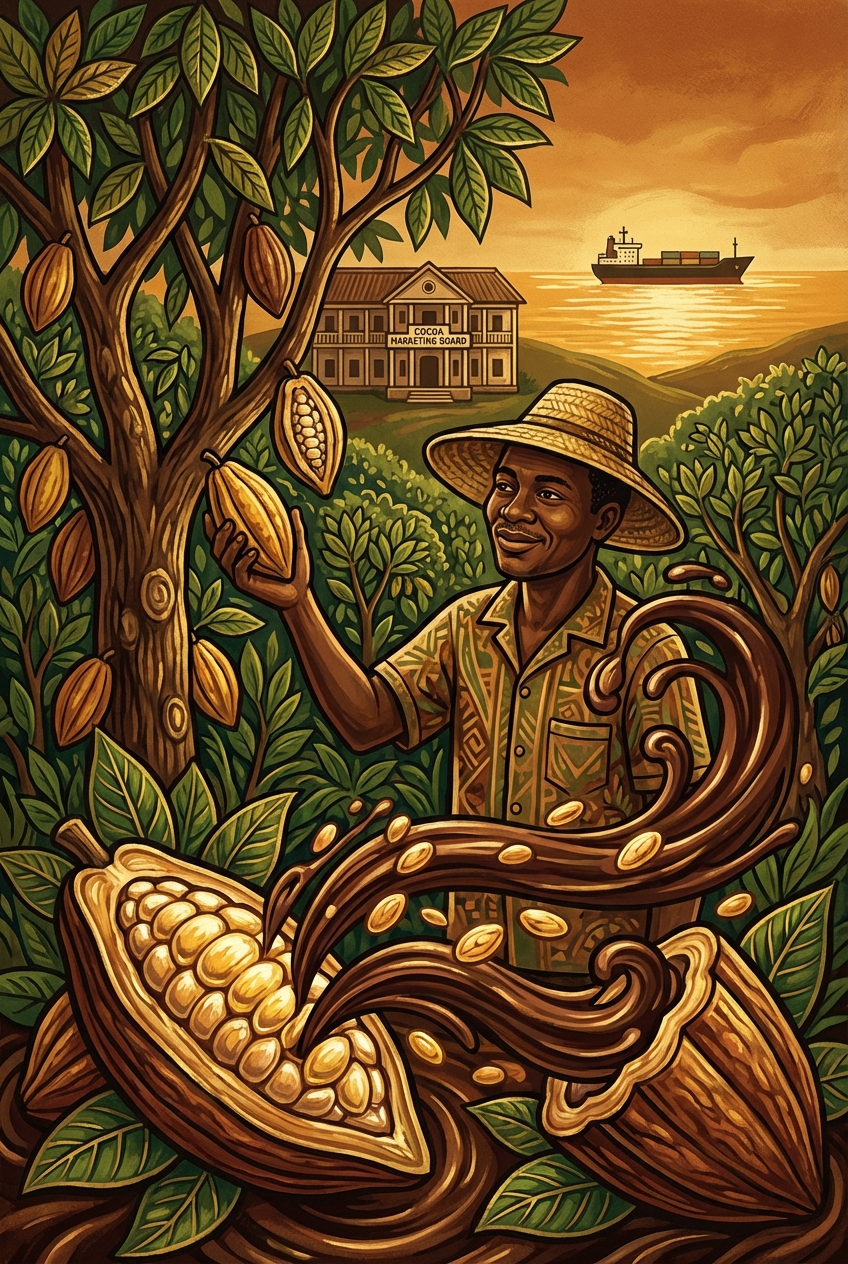
"Golden Pods, Global Power" meticulously chronicles Ghana's ascent as a cocoa-producing giant, exploring the intricate interplay of indigenous agency, colonial policies, and global market forces. The book traces the early adoption of cocoa farming, starting with Tetteh Quarshie's pivotal introduction of the crop and its subsequent spread through the resourcefulness of Akan farmers -- particularly *nkwankwaa* (young men) seeking economic independence. It examines how traditional land tenure systems, while initially facilitating cocoa cultivation, later became points of contention with the imposition of colonial land laws and the rise of absentee landlordism. A central theme is the evolving relationship between Ghanaian farmers and the colonial administration, analyzing how farmers navigated discriminatory pricing policies implemented by European trading firms like the United Africa Company (UAC). The book also explores the farmers’ resistance to these policies, including the famous Cocoa Hold-Up of the 1930s -- a landmark event in Ghana’s economic history that showcased the farmers’ collective bargaining power and anti-colonial sentiment. The narrative then progresses into the post-independence era, scrutinizing the policies of successive governments aimed at managing the cocoa sector, from the Cocoa Marketing Board (COCOBOD) established under Kwame Nkrumah, to subsequent attempts at liberalization. The book assesses the successes and failures of these interventions, considering their impact on farmer livelihoods, national revenue, and environmental sustainability. Furthermore, it delves into contemporary challenges such as climate change, deforestation, and child labor in cocoa production, offering a nuanced perspective on the ethical considerations of Ghana’s cocoa industry. Ultimately, "Golden Pods, Global Power" presents a comprehensive and critical account of Ghana's cocoa journey, shedding light on its lasting impact on the nation’s economy, society, and identity.
About the Author
The scholarship on Ghana's cocoa industry is rich and diverse, drawing upon the expertise of historians, economists, anthropologists, and agricultural scientists. Pioneers such as Polly Hill, whose detailed ethnographic studies on Akan cocoa farmers provided invaluable insights into their socio-economic organization, laid the groundwork for subsequent research. Gareth Austin's work has illuminated the colonial economic structures that shaped the cocoa trade, while scholars like Bjorn Beckman have critically examined the role of the state and its interventions in the cocoa sector. More recently, researchers have focused on issues of sustainability, fair trade, and the ethical dimensions of cocoa production. "Golden Pods, Global Power" builds upon this extensive body of work, incorporating both established scholarship and contemporary perspectives to offer a comprehensive understanding of Ghana's cocoa story.
Key Themes
- Economic agency
- Colonial extraction
- Agricultural innovation
- Land tenure systems
- Farmer resistance
- State intervention
- Sustainability challenges
Why This Matters
Ghana's cocoa story is far more than a tale of agricultural success; it's a microcosm of the nation's broader historical trajectory, reflecting its engagement with global capitalism, its struggle for economic sovereignty, and its ongoing pursuit of sustainable development. This narrative matters profoundly for understanding Ghanaian and African heritage because it illuminates the resilience, ingenuity, and agency of African farmers in the face of colonial exploitation and post-colonial challenges. The story of cocoa connects the diaspora to a tangible piece of their heritage, demonstrating the economic power and entrepreneurial spirit of their ancestors. For students, it provides a valuable case study in economic history, agricultural development, and the complexities of global trade, highlighting the ethical considerations of consumption and production in a globalized world. The legacy of cocoa informs contemporary debates about land rights, fair trade, and environmental sustainability, making it a crucial topic for understanding Ghana's present and future.
Historical and Cultural Context
Ghana's cocoa story is intricately linked to broader themes in African history. The cocoa boom mirrors similar agricultural transformations across the continent, such as the groundnut cultivation in Senegal and cotton production in Egypt, each revealing the complex interactions between local producers and global markets. Within the Sankofa Library, this book complements narratives of colonial resource extraction, labor exploitation, and resistance movements. It also connects with accounts of African entrepreneurship and adaptation in the face of economic challenges. Understanding the cocoa story enriches our appreciation of Ghana's role in shaping global commodity chains and its contribution to Pan-African economic thought.
Sources & References
- Hill, Polly. The Migrant Cocoa-Farmers of Southern Ghana: A Study in Rural Capitalism. Cambridge University Press, 1963.
- Mikell, Gwendolyn. Cocoa and Chaos in Ghana. Paragon House Publishers, 1989.
- Howard, Rhoda. Colonialism and Underdevelopment in Ghana. Croom Helm, 1978.
- Austin, Gareth. Labour, Land and Capital in Ghana: From Slavery to Free Labour in Asante, 1807-1956. University of Rochester Press, 2005.
- Adu-Ampong, Seth. 'The Cocoa Economy and Its Impact on Rural Livelihoods in Ghana, 1879-1957.' PhD diss., West Virginia University, 2013.