Keyboard shortcuts
- J: Next chapter
- K: Previous chapter
- T: Toggle table of contents
- Shift+S: Share book
- +: Increase font size
- -: Decrease font size
- Escape: Close modals
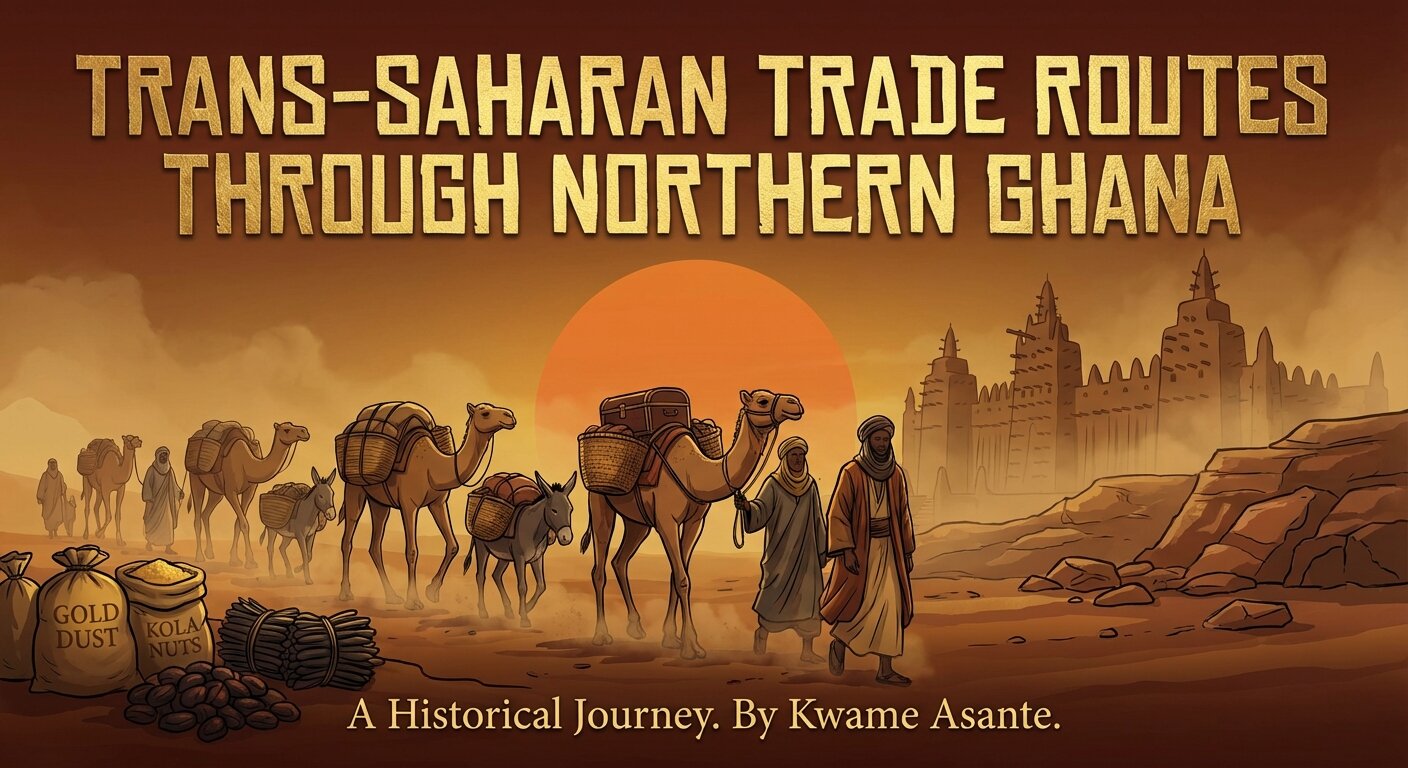
Trans-Saharan Trade Routes Through Northern Ghana
- Trans-Saharan Trade
- Salaga
- Kola Nut Trade
- Gold Trade
- Begho
- Daboya
- Gonja Kingdom
- Hausa Traders
- Slave Trade
- Islam in Ghana
- Northern Ghana
- Wangara
- Pre-colonial Commerce
- Larabanga Mosque
Chapter 1
Part 1
In the dry season of 1876, the French explorer Louis-Gustave Binger arrived at the gates of Salaga, a town in the East Gonja District of what is now Ghana's Savannah Region, and recorded his astonishment. Before him spread a market so vast, so cosmopolitan, and so commercially sophisticated that he compared it to the legendary Timbuktu itself. Hausa traders from Kano and Katsina haggled with Asante merchants over baskets of kola nuts. Wangara scholars from the Niger Bend traded manuscripts and amulets alongside bolts of North African cloth. Dagomba horsemen led caravans of cattle and groundnuts from Yendi. And everywhere, the currency of the savannah changed hands: cowrie shells, gold dust, blocks of Saharan salt cut from the mines of Taghaza and Taoudenni. Salaga, known to traders across West Africa as "the Timbuktu of the South," was the living proof that for centuries before European ships touched the Gold Coast, northern Ghana had been woven into a vast commercial network stretching across the Sahara to the Mediterranean and beyond.
The trans-Saharan trade routes that passed through northern Ghana were not a single road but a web of interconnected paths, developed over more than a millennium. The oldest routes connected the goldfields of the Akan forest, in what is now southern Ghana, to the great entrepôts of the western Sudan: Djenné, Timbuktu, and Gao on the Niger River. From there, goods crossed the Sahara to North African ports like Sijilmasa in Morocco, Ghadames in Libya, and the cities of Ifriqiya (modern Tunisia). The journey from the forest edge to the Mediterranean could take six months or more, passing through multiple ecological zones: dense tropical forest, the transitional Guinea savannah, the dry Sudan savannah, the semi-arid Sahel, and finally the vast emptiness of the Sahara itself.
Gold was the commodity that first drew the trans-Saharan trade through the territories of modern Ghana. The Akan goldfields, particularly those around Bono-Manso (near present-day Techiman in the Bono Region), were among the richest in West Africa. Arab geographers knew of this gold by the 8th century: the great polymath al-Fazari, writing around 773 CE, referred to "Ghana" as "the land of gold," though he was describing the Ghana Empire far to the northwest, which controlled the northern terminus of the gold trade. By the 11th century, the geographer al-Bakri recorded that the ruler of Ghana taxed every donkey-load of gold entering or leaving his domain, a system that generated enormous revenue and financed a court of legendary splendour.
About This Book
"Trans-Saharan Trade Routes Through Northern Ghana" illuminates a pivotal chapter in Ghana's pre-colonial history, revealing the intricate network of commerce and cultural exchange that flourished for centuries before European arrival. The book meticulously traces the routes that snaked through northern Ghana, transforming towns like Begho, Daboya, Yendi, and Salaga into bustling commercial hubs. Begho, renowned for its crafts and agricultural production, served as a key entry point for goods flowing south towards the Akan forest and north towards the Sahel. Daboya, with its strategic location near the White Volta River, became a major salt production and distribution center. Yendi, the capital of Dagbon, exerted significant political control over trade routes, influencing the flow of commodities and acting as a nexus for diplomacy. And Salaga, later christened the "Timbuktu of the South," rose to prominence as a marketplace where traders from diverse backgrounds converged to exchange gold, kola nuts, salt, textiles, and tragically, enslaved people. The narrative explores the profound impact of this trade on the political landscape, detailing how the wealth generated from commerce fueled the rise of powerful kingdoms and chiefdoms. It examines the religious dimensions, tracing the spread of Islam through trade networks and the syncretic religious practices that emerged as different belief systems interacted. Readers will gain insight into the social transformations wrought by trade, understanding the emergence of merchant classes, the development of specialized crafts, and the complex hierarchies that shaped pre-colonial society. The book acknowledges the darker aspects of the trade, including the trade in enslaved people, and critically examines its impact on communities across the region. It provides a nuanced understanding of the intricate dynamics that connected northern Ghana to the wider world, highlighting its crucial role in the economic and cultural exchange that shaped the African continent.
About the Author
The study of trans-Saharan trade in Ghana has been shaped by generations of dedicated historians and archaeologists. Pioneers like Ivor Wilks, whose work on Asante and its interactions with the north remains foundational, demonstrated the importance of oral traditions alongside archival sources. Nehemia Levtzion contributed significantly to understanding Islam's role in the trade and its impact on the region's social and political structures. More recent scholars such as Ray Kea have explored the economic dimensions of the trade in depth, examining the production and distribution of commodities like gold and kola. Archaeological investigations, particularly at sites like Begho, continue to provide invaluable material evidence, complementing textual sources and offering new perspectives on the daily lives of those involved in the trade. This book draws upon this rich tradition of scholarship, synthesizing diverse sources to provide a comprehensive account of northern Ghana's role in the trans-Saharan trade network.
Key Themes
- Trans-Saharan trade
- Economic networks
- Cultural exchange
- Islam in Ghana
- Pre-colonial kingdoms
- Commodity trade
- Salaga
Why This Matters
Understanding the trans-Saharan trade is crucial for grasping the historical roots of Ghana's economic and cultural development. This pre-colonial network laid the foundation for many of the country's trade routes and urban centers. It demonstrates that Ghana was not isolated before European contact but was actively engaged in global exchanges. For the diaspora, this history reveals the sophistication and interconnectedness of African societies, challenging simplistic narratives of a continent untouched by global dynamics. For students, it offers a valuable case study of how trade shapes political power, cultural identity, and social structures. Engaging with this story allows us to reclaim a narrative of African agency and innovation, recognizing the ingenuity and resilience of the people who built and sustained these vital trade routes. This is a critical part of understanding the longer story of African interactions with the world.
Historical and Cultural Context
This book builds upon the Library’s other entries documenting pre-colonial Ghanaian history. It connects directly to texts on the rise of Asante, demonstrating how access to northern trade routes contributed to Asante's power. It also relates to entries on Islam in West Africa, showing how trade facilitated the spread of Islamic ideas and institutions. The story of Salaga, as a major trade entrepôt, echoes the stories of other important commercial centers across West Africa, such as Kano or Jenne, offering a comparative perspective on the dynamics of trade and urbanization. Understanding the trans-Saharan trade allows for a more nuanced appreciation of the subsequent impact of the transatlantic slave trade and colonial rule, revealing the complex interplay of internal and external forces that have shaped Ghanaian history.
Sources & References
- Wilks, Ivor. 'Wangara, Akan, and Portuguese in the Fifteenth and Sixteenth Centuries.' Journal of African History 23:3 (1982).
- Posnansky, Merrick. 'Begho and the Origins of Akan Civilization.' Ghana Notes and Queries 9 (1966).
- Lovejoy, Paul E. Caravans of Kola: The Hausa Kola Trade 1700-1900. Ahmadu Bello University Press, 1980.
- Rattray, R.S. Tribes of the Ashanti Hinterland. Oxford University Press, 1932.
- Wilks, Ivor. Forests of Gold: Essays on the Akan and the Kingdom of Asante. Ohio University Press, 1993.
- Dupuis, Joseph. Journal of a Residence in Ashantee. Henry Colburn, 1824.
- Levtzion, Nehemia. Muslims and Chiefs in West Africa. Oxford University Press, 1968.
- Goody, Jack. 'The Over-Kingdom of Gonja.' In West African Kingdoms in the 19th Century, edited by Daryll Forde and P.M. Kaberry. Oxford University Press, 1967.
- Krause, Gottlob Adolf. 'Bericht über Salaga.' Petermanns Geographische Mitteilungen 38 (1892).