Keyboard shortcuts
- J: Next chapter
- K: Previous chapter
- T: Toggle table of contents
- Shift+S: Share book
- +: Increase font size
- -: Decrease font size
- Escape: Close modals
Chapter 1
Part 1
On the cold morning of January 13, 1972, Colonel Ignatius Kutu Acheampong, commanding officer of the First Brigade based in Accra, led a column of soldiers from Burma Camp toward Christiansborg Castle and the key installations of the Ghanaian capital. By midday, Prime Minister Kofi Abrefa Busia's Progress Party government, the civilian administration of the Second Republic, had been overthrown without a single shot fired. Busia himself was in London receiving medical treatment. He would never return to power. Acheampong, a 40-year-old officer from Kumasi who had trained at Fort Leavenworth in Kansas, announced the formation of the National Redemption Council (NRC) and declared: "The old order has changed. A new Ghana is born."
The immediate trigger for the coup was Busia's economic austerity program, particularly the devastating 44 percent devaluation of the cedi on December 27, 1971, carried out on the advice of the International Monetary Fund. The devaluation wiped out the savings of the Ghanaian middle class overnight. Soldiers saw their purchasing power collapse. The price of imported goods, including the spare parts and equipment the military depended on, soared. When Busia simultaneously announced budget cuts that reduced military allowances and benefits, the officer corps reached its breaking point. As Acheampong told the nation in his first broadcast, the Busia government had "callously reduced the standard of living of every Ghanaian."
Acheampong's early months were genuinely popular. He reversed the cedi devaluation, repudiated $94 million in debts owed to British firms that Ghanaians considered exploitative colonial-era obligations, and launched what would become his signature initiative: Operation Feed Yourself (OFY). Announced in 1972, OFY was an ambitious agricultural self-sufficiency program that encouraged every Ghanaian, from civil servants to schoolchildren, to grow food. Backyard gardens sprang up across Accra and Kumasi. Government land was allocated for farming cooperatives. Rice production at the Dawhenya and Afife irrigation projects expanded significantly. In its first two years, OFY was a genuine success, reducing food imports and instilling a sense of national pride. Even Acheampong's critics acknowledged that the program, at least initially, addressed a real problem: Ghana's dangerous dependence on imported food.
About This Book
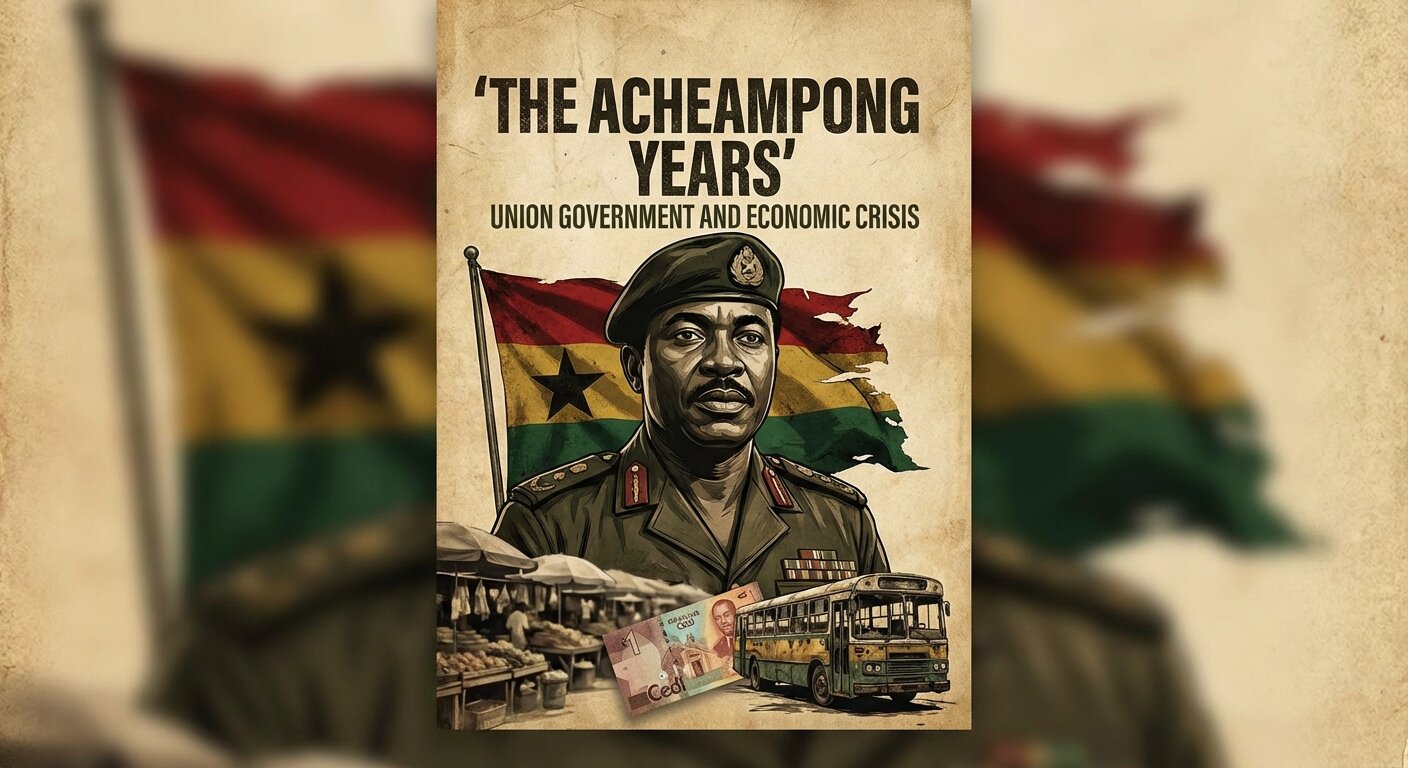
"The Acheampong Years: Union Government and Economic Crisis" delves into one of the most complex and debated periods in Ghana's post-independence history. It meticulously charts the rise of General Ignatius Kutu Acheampong, who seized power in a 1972 coup, overthrowing the democratically elected government of Dr. Kofi Abrefa Busia. The article provides a nuanced examination of Acheampong's "Operation Feed Yourself" (OFY) program, aimed at achieving agricultural self-sufficiency. While initially greeted with optimism, OFY is scrutinized for its uneven implementation, ultimately failing to address underlying structural issues in the agricultural sector and contributing to burgeoning corruption. The work meticulously details the unraveling of Ghana's economy under Acheampong's leadership. It analyzes the impact of global oil shocks, mismanagement of state resources, and widespread corruption on the country's economic decline. The article explores the strategies employed by the Acheampong regime to cope with the crisis, including attempts at price controls, import restrictions, and reliance on foreign loans, highlighting their ultimate ineffectiveness. Central to the narrative is the controversial concept of "Union Government" (Unigov), Acheampong's proposal for a non-party system of government blending military, police, and civilian participation. The article analyzes the motivations behind Unigov, exploring whether it was a genuine attempt to foster national unity or a thinly veiled effort to perpetuate military rule. It examines the fierce opposition to Unigov from students, intellectuals, and lawyers, who viewed it as an authoritarian power grab. The culmination of the article is a detailed account of the 1978 referendum on Unigov, its disputed results, and the subsequent events that led to Acheampong's ouster in a palace coup. The article offers a critical analysis of Acheampong's legacy, providing a balanced assessment of his achievements and failures.
About the Author
The scholarship on the Acheampong era is diverse and often politically charged, reflecting the deep divisions the period engendered. Works like "Ghana: The Burden of Democracy, 1969-2001" by Dr. Naomi Chazan provide a broader political context, while publications from the period itself, like those in the *Daily Graphic* and *Ghanaian Times*, offer valuable primary source material, though often filtered through the regime's propaganda. Scholars such as Donald Rothchild have examined the economic policies of the time in detail. Oral histories, often collected by institutions like the Institute of African Studies at the University of Ghana, Legon, are crucial for understanding the lived experiences of Ghanaians during this era, supplementing the official record. The work builds upon this foundation, weaving together diverse sources to create a comprehensive and critical account.
Key Themes
- Military rule
- Economic crisis
- Agricultural policy
- Political opposition
- Union Government
- Corruption
- National identity
Why This Matters
The Acheampong era is a pivotal chapter in Ghana's history, offering critical lessons about governance, economic management, and the dangers of authoritarianism. Understanding this period is crucial for grasping the complexities of Ghana's post-independence trajectory and the challenges it continues to face. The "Operation Feed Yourself" program, despite its failures, speaks to the enduring aspiration for food security and self-reliance in Ghana and across Africa. The Unigov debate highlights the perennial tension between civilian rule and military intervention in African politics.
For the diaspora, the Acheampong years provide a window into a period of immense hardship and resilience, underscoring the importance of good governance and economic justice. For students, this era offers a valuable case study in political economy, demonstrating the interconnectedness of political decisions, economic policies, and social outcomes. Studying this era allows for critical engagement with narratives of development and progress in Africa, moving beyond simplistic accounts to grapple with the complexities of historical experience.
Historical and Cultural Context
The Acheampong era must be understood within the broader context of Cold War politics and the post-colonial economic challenges facing many African nations. Ghana's experience was not unique; many countries grappled with economic instability, political upheaval, and the allure of authoritarian solutions. Examining this period alongside similar developments in countries like Nigeria, Zaire (now the Democratic Republic of Congo), and Uganda provides valuable comparative perspectives. Within the Sankofa Digital Heritage Library, this article complements other works examining post-independence nation-building, economic development strategies, and the role of the military in African politics.
Sources & References
- Oquaye, Mike. Politics in Ghana, 1972-1979. Tornado Publications, 1980.
- Petchenkine, Youry. Ghana in Search of Stability, 1957-1992. Praeger, 1993.
- Shillington, Kevin. Ghana and the Rawlings Factor. Macmillan, 1992.
- Boahen, A. Adu. The Ghanaian Sphinx: Reflections on Contemporary History. Sankofa Educational Publishers, 1989.
- Ray, Donald I. Ghana: Politics, Economics and Society. Frances Pinter, 1986.