Keyboard shortcuts
- J: Next chapter
- K: Previous chapter
- T: Toggle table of contents
- Shift+S: Share book
- +: Increase font size
- -: Decrease font size
- Escape: Close modals
Chapter 1
Part 1
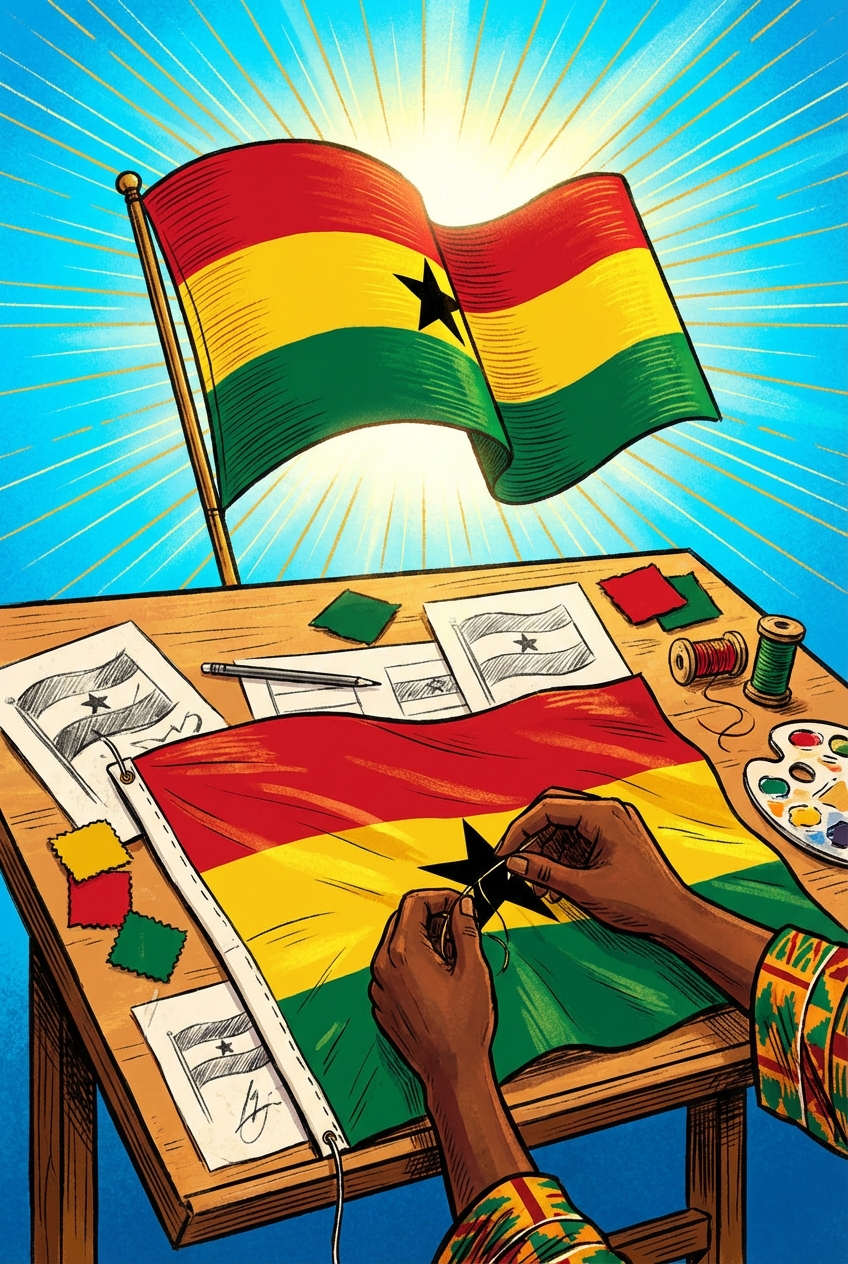
Every nation on earth has a flag, but very few know the name of the person who designed it. In Ghana, that person is Theodosia Salome Okoh, an artist, teacher, sports administrator, and national heroine whose single most enduring contribution to the country can be seen flying above every government building, school, and embassy in the world where Ghana is represented. The red, gold, and green tricolor with its bold black star at the center is one of the most instantly recognizable flags on the African continent, a powerful visual declaration of independence, Pan-African solidarity, and the promise of a new dawn for the Black world.
Yet, to remember Theodosia Okoh solely as the "woman who designed the flag" is to drastically reduce the scope of her remarkable life. She was a pioneering educator who championed art and creativity at a time when the colonial curriculum prioritized rote learning and clerical skills. She was a fierce sports administrator who almost single-handedly built Ghana's national hockey program from nothing, defending it against institutional neglect and political interference for over five decades. This narrative explores the full arc of her life, from her childhood in the Gold Coast, through the electrifying moment of flag selection in 1957, to her tireless decades of advocacy for sports and culture, and her fierce defense of her own legacy.
Theodosia Salome Okoh was born on June 21, 1922, in the town of Anum in the Eastern Region of the Gold Coast. She was raised in a family that valued both education and cultural expression. Her father was a teacher and lay preacher, and the family home was filled with books, hymns, and lively discussions about the future of the Gold Coast. From a young age, Theodosia displayed a sharp eye for visual aesthetics and a natural talent for drawing and design.
She received her early education at the local Presbyterian schools before enrolling at Achimota College, arguably the most important educational institution in the history of modern Ghana. Achimota, founded in 1927 with the motto "Ut Omnes Unum Sint" (That All May Be One), was unique in the colonial Gold Coast. It was co-educational, it admitted students regardless of racial background, and its curriculum actively sought to integrate African cultural traditions with Western academic disciplines. The school's emphasis on art, music, and craft, alongside the standard academic subjects, had a profound impact on the young Theodosia.
About This Book
"Theodosia Okoh: Designer of Ghana's Flag" is a vital contribution to Ghanaian historical literature, offering a detailed account of the creation of one of the nation's most potent symbols -- its flag. The book meticulously traces the life and artistic development of Theodosia Salome Okoh (née Asihene), born in 1922, providing context for her later triumph in designing the flag. Crucially, it contextualizes her artistic inclinations within the burgeoning nationalist sentiment of the pre-independence era. The book will detail the intense national competition launched in 1957 in anticipation of Ghana's independence, under the leadership of Kwame Nkrumah. It delves into the parameters of the competition, the submissions received, and the meticulous selection process that ultimately led to Okoh's design being chosen. The book reveals the profound symbolism embedded within the flag's colours -- red representing the blood shed for independence, gold representing the country's mineral wealth, green symbolizing Ghana's rich forests, and the black star representing African emancipation and unity. It clarifies the significance of each element, correcting misconceptions and reinforcing the intended meaning. Beyond the design itself, the book explores Okoh's unwavering commitment to her creation. It documents her role in preserving the flag's integrity over the decades, her active participation in national events where the flag was displayed, and her efforts to educate younger generations about its importance. This narrative also brings to light the controversy surrounding the naming of the national hockey pitch after her, highlighting the public debates and the eventual presidential intervention to restore her name, illustrating the profound respect and recognition she ultimately received from the nation. The book serves as a biography and a testament to the power of individual creativity in shaping national identity and should provide a nuanced understanding of flag design, the history of symbolism, and the importance of safeguarding national heritage.
About the Author
While a singular definitive biography remains somewhat scarce, the legacy of Theodosia Okoh has been preserved through various avenues of Ghanaian scholarship. Oral history projects, particularly those conducted by the Institute of African Studies at the University of Ghana, Legon, have documented personal accounts from Okoh herself and those who knew her. The Ghana Museums and Monuments Board maintains archives containing documents and artifacts related to the flag's design and production. Journalists and writers such as Elizabeth Ohene, have contributed significantly through newspaper articles and essays, reflecting on Okoh's life and impact, preserving memories and details about her life. Furthermore, academic research in art history and political science has explored the symbolism of the Ghanaian flag within the broader context of African nationalism and decolonization. This book builds upon these foundations, synthesizing available information and offering a comprehensive narrative.
Key Themes
- National Identity
- Symbolism
- Ghanaian Art & Design
- Independence Movement
- Cultural Heritage
- Nationalism
Why This Matters
The story of Theodosia Okoh and the Ghanaian flag holds immense significance for understanding Ghanaian and African heritage. It underscores the critical role of art and design in shaping national consciousness and fostering a sense of collective identity. The flag itself embodies the aspirations and sacrifices of a nation striving for liberation and self-determination. Its enduring power lies in its ability to evoke a shared history, a common purpose, and a vision for the future.
For the diaspora, this story serves as a powerful reminder of their ancestral homeland and the struggles for independence that paved the way for their own opportunities. It provides a tangible connection to their cultural roots and encourages a deeper engagement with Ghanaian history and traditions. For students, this book offers a compelling case study of how cultural symbols can be used to mobilize populations, promote unity, and inspire national pride. It also highlights the importance of preserving and celebrating the contributions of individuals who have shaped the nation's identity and allows them to see the importance of flag design, a topic often overlooked in the history of Ghana.
Historical and Cultural Context
The creation of the Ghanaian flag in 1957 occurred within the broader context of the Pan-African movement and the wave of decolonization sweeping across the African continent. Ghana's independence served as an inspiration for other African nations seeking to break free from colonial rule. The black star on the flag, borrowed from Marcus Garvey's Black Star Line, symbolized this solidarity and the shared aspirations of Africans worldwide. Within the Sankofa Digital Heritage Library, this story connects to narratives of anti-colonial resistance, political activism, and cultural revivalism that defined the era. Further examination of related texts about Kwame Nkrumah's leadership, the development of Ghanaian national identity, and the cultural impact of independence would enrich the reader's understanding of the significance of Theodosia Okoh's contribution.