Keyboard shortcuts
- J: Next chapter
- K: Previous chapter
- T: Toggle table of contents
- Shift+S: Share book
- +: Increase font size
- -: Decrease font size
- Escape: Close modals
Chapter 1
Part 1
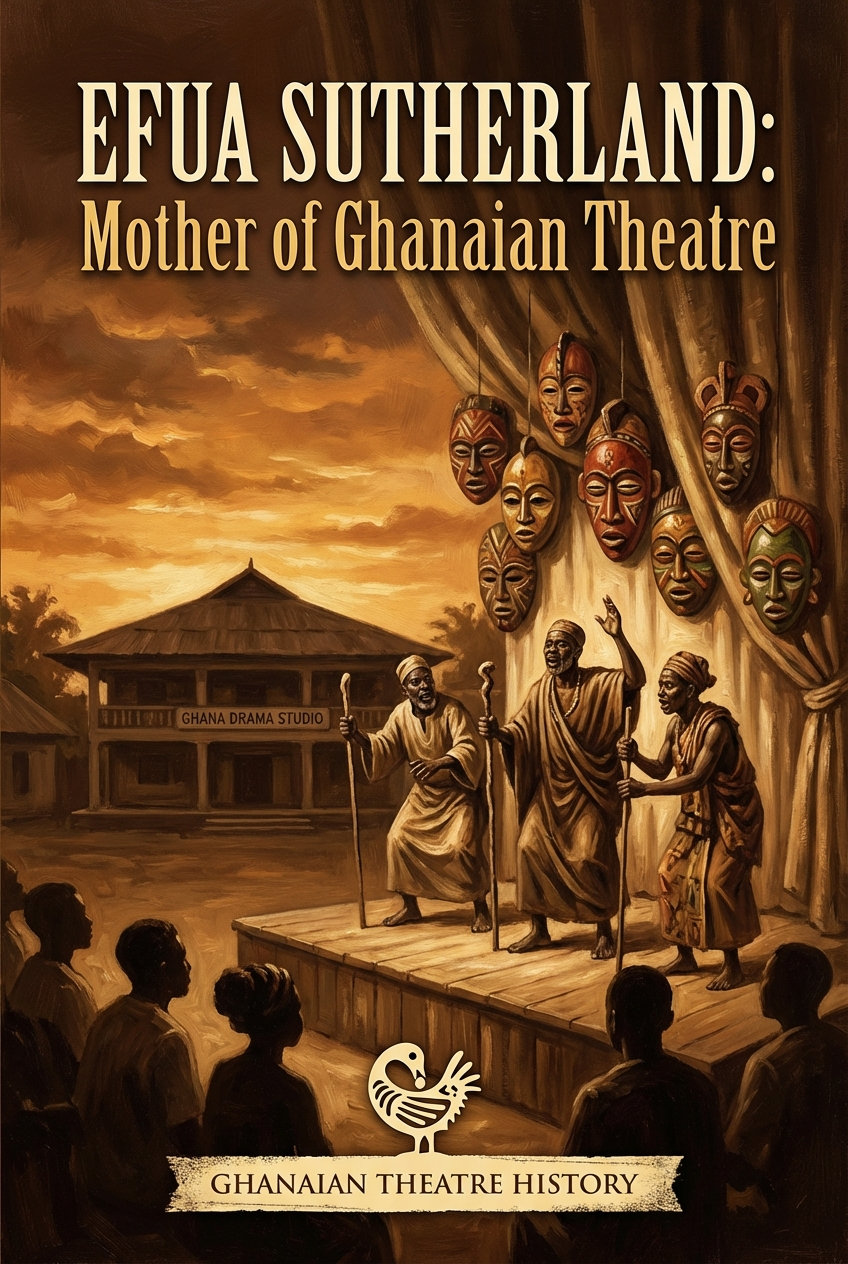
In the story of Ghana's cultural independence, the name Efua Theodora Sutherland occupies a sacred space. She is widely revered as the mother of modern Ghanaian theatre, but her title encompasses much more than playwriting. Born in 1924 in Cape Coast, Sutherland was a visionary educator, a children's author, a research scholar, and an institutional architect who dedicated her life to decolonizing the African mind. While political leaders fought to remove the British flag and establish self-governance, Sutherland fought an equally vital battle on the cultural front. She understood that a nation could not truly be free if its people continued to dream, perform, and tell stories using the borrowed frameworks of their former colonizers.
This narrative explores her foundational role in creating a uniquely Ghanaian theatrical tradition. It traces her journey from a colonial classroom to the establishment of the Ghana Drama Studio, her pioneering research into indigenous oral literature, and her creation of the Kusum Agoromba (Kusum Players), a touring theatre group that brought dramatic arts out of elite university halls and directly into rural communities. Sutherland's life was a masterclass in cultural reclamation, proving that art is not a luxury for the newly independent state, but the very soil in which national identity takes root.
Efua Sutherland grew up in the culturally rich environment of Cape Coast, the historic former capital of the Gold Coast and a major center of colonial education. She attended St. Monica's School in Mampong and later trained as a teacher at the Achimota College, an institution known for producing the intellectual vanguard of the independence movement. She subsequently traveled to the United Kingdom, studying at Homerton College in Cambridge and the School of Oriental and African Studies (SOAS) at the University of London.
Her exposure to the British educational system, both at home and abroad, illuminated a glaring cultural deficit. The literature, plays, and poetry she was taught were overwhelmingly European. African children were memorizing Shakespearean sonnets and performing Victorian drawing-room comedies, texts that held no reflection of their own realities, histories, or spiritual beliefs. Sutherland realized that this cultural erasure was a deliberate mechanism of colonial control, designed to instill a sense of inferiority and reliance on European aesthetics.
Upon returning to Ghana in the early 1950s, she made a radical decision. She would not simply write plays about Africans using European dramatic structures. Instead, she would excavate and elevate the indigenous storytelling traditions of her people, specifically the Anansesem (spider tales) of the Akan people, and adapt them into a formal theatrical framework. She coined the term "Anansegoro" to describe this new genre of drama. It was a theatrical form that integrated storytelling, music, dance, and audience participation, mirroring the communal experience of traditional village life rather than the passive, silent observation of a Western theatre audience.
About This Book
"Efua Sutherland: Mother of Ghanaian Theatre" delves into the life and monumental contributions of Efua Theodora Sutherland, a pivotal figure in shaping Ghanaian theatre and cultural identity during the nation's formative years. The book explores Sutherland's vision for a theatre that reflected and celebrated Ghanaian traditions, moving away from colonial influences that had dominated the art scene. It meticulously details her early life, her education in both Ghana and England, and her growing awareness of the need to preserve and promote indigenous Ghanaian storytelling traditions. A central focus is Sutherland's groundbreaking work in establishing the Ghana Drama Studio in 1958. The book illuminates how the Drama Studio became a hub for experimentation, training, and the development of new playwrights, actors, and technicians. It showcases how Sutherland fostered a collaborative environment, encouraging artists to draw inspiration from Ghanaian folklore, music, and dance. It explores the Anansegoro movement which Sutherland pioneered -- the act of drawing on traditional Ananse storytelling (spider tales) to creatively craft stories and plays for the stage -- a deliberate project to indigenize Ghanaian theatre. The book further examines Sutherland's role in advocating for children's literature and education, highlighting her creation of the Kodzidan (Story House) in Ekumfi Atwia, her hometown. It showcases her commitment to capturing and preserving traditional oral narratives through extensive fieldwork and recordings. It also covers her involvement in Pan-African cultural initiatives, cementing her status as a leading voice in the movement for cultural decolonization across the continent. Readers will learn about the challenges Sutherland faced in navigating post-independence Ghana, including political and economic constraints, and her enduring legacy in inspiring generations of Ghanaian artists and cultural practitioners. Ultimately, it's a celebration of her dedication to forging a uniquely Ghanaian theatrical identity rooted in indigenous forms and narratives.
About the Author
The scholarship on Efua Sutherland and Ghanaian theatre is rich and varied, drawing from fields like literary studies, theatre history, and African studies. Early works often focused on documenting Sutherland's plays and analyzing their themes of cultural identity and social change. Scholars like Anne Adams and James Gibbs contributed significantly to this early body of work. More recent scholarship emphasizes the intersectionality of Sutherland's work, exploring her contributions to children's literature, her role in Pan-Africanism, and her advocacy for women in the arts. This book builds upon this established tradition of scholarship, drawing from archival materials, personal interviews, and critical analyses of Sutherland's oeuvre. It reflects a continuing commitment to understanding and celebrating the legacy of this influential figure in Ghanaian cultural history. It is indebted to the foundational work of scholars like Esi Sutherland-Addy (Efua Sutherland's daughter), whose biography further illuminates the life and impact of Efua Sutherland.
Key Themes
- Cultural Nationalism
- Decolonization
- Oral Tradition
- Theatre for Development
- Pan-Africanism
- Children's Literature
Why This Matters
Efua Sutherland's story is profoundly significant for understanding Ghanaian and African heritage because it epitomizes the struggle for cultural self-determination in the wake of colonialism. Her work in establishing a distinctly Ghanaian theatre tradition was a direct response to the cultural dominance of the West, demonstrating the power of art to reclaim and celebrate indigenous identities.
This topic matters today because it reminds us of the ongoing need to preserve and promote African cultural heritage in a globalized world. Sutherland's emphasis on oral traditions and community engagement remains relevant as we seek to connect with our roots and foster a sense of belonging. For the diaspora, understanding Sutherland's work offers a vital link to their ancestral heritage and a source of inspiration for creating art that reflects their unique experiences. Students will find in Sutherland's story a powerful example of how individuals can use their talents and creativity to effect social change and contribute to the building of a nation.
Historical and Cultural Context
The story of Efua Sutherland and the development of Ghanaian theatre is inextricably linked to the broader context of Pan-Africanism and the independence movements that swept across the continent in the mid-20th century. As Ghana gained independence in 1957, under the leadership of Kwame Nkrumah, there was a conscious effort to promote a new national identity that was rooted in African culture and traditions. Sutherland's work in creating a distinctly Ghanaian theatre tradition aligned perfectly with Nkrumah's vision of a culturally vibrant and independent nation. This book also connects with other materials in the Sankofa Library that document the role of art and culture in shaping national identities and promoting social change in Africa.