Keyboard shortcuts
- J: Next chapter
- K: Previous chapter
- T: Toggle table of contents
- Shift+S: Share book
- +: Increase font size
- -: Decrease font size
- Escape: Close modals
Chapter 1
Part 1
The history of Ghana is permanently intertwined with the life and vision of one man. His name was Kwame Nkrumah. While he is universally recognized as the architect of Ghanaian independence and a towering figure of the Pan-African movement, the man behind the monument is often obscured by the sheer weight of his own legacy. Textbooks highlight his fiery speeches and his triumphant declaration of independence in 1957, but they rarely delve into the profound psychological journey of a village boy from Nkroful who grew up to challenge the greatest empires on earth.
This narrative goes beyond the traditional political summaries. It explores the formative years Nkrumah spent in the United States, his intellectual awakenings, his strategic brilliance in mobilizing the common people, and the intense personal sacrifices he made for his vision of a United States of Africa. The story of Kwame Nkrumah is not merely a chronicle of political victories. It is a deeply humanizing look at ambition, isolation, ideological evolution, and the tragic consequences of a dream that moved faster than the continent was prepared to follow. By examining his life from his early struggles to his final days in exile in Conakry, we can understand the immense pressures that shaped the first president of Ghana.
## The Formative Years in America
To understand the political ideology of Kwame Nkrumah, one must first look at the decade he spent navigating the harsh realities of the United States during the Great Depression. Born in 1909 in the small village of Nkroful in the Western Region of the Gold Coast, Nkrumah showed early academic promise. He trained as a teacher at Achimota College under the guidance of influential educators like James Aggrey, who instilled in him a profound sense of racial pride and the importance of African self-reliance. However, it was his decision to travel abroad for further education that truly radicalized him.
In 1935, Nkrumah arrived in America with barely any money in his pocket. He enrolled at Lincoln University in Pennsylvania, a historically Black university that became the crucible for his political awakening. Life in America was not easy for the young African student. To pay his tuition and support himself, he took on a series of grueling jobs. He worked in a soap factory, slung hash as a dishwasher, and even sold fish on the streets of Harlem. These experiences of abject poverty and relentless hard work exposed him to the visceral realities of capitalism and racial discrimination. He witnessed firsthand the systemic oppression faced by African Americans, drawing direct parallels between their struggles and the colonial subjugation of his people back home.
During his time at Lincoln and later at the University of Pennsylvania, Nkrumah immersed himself in radical literature. He read the works of Karl Marx, Vladimir Lenin, and most importantly, the Jamaican Black nationalist Marcus Garvey. Garvey's philosophy of "Africa for the Africans" deeply resonated with Nkrumah. He devoured copies of Garvey's newspaper, The Negro World, and became convinced that the only path forward for the continent was total political unification and economic independence. Furthermore, his interactions with prominent African American intellectuals like W.E.B. Du Bois and Paul Robeson provided him with a broader global perspective on race and imperialism.
About This Book
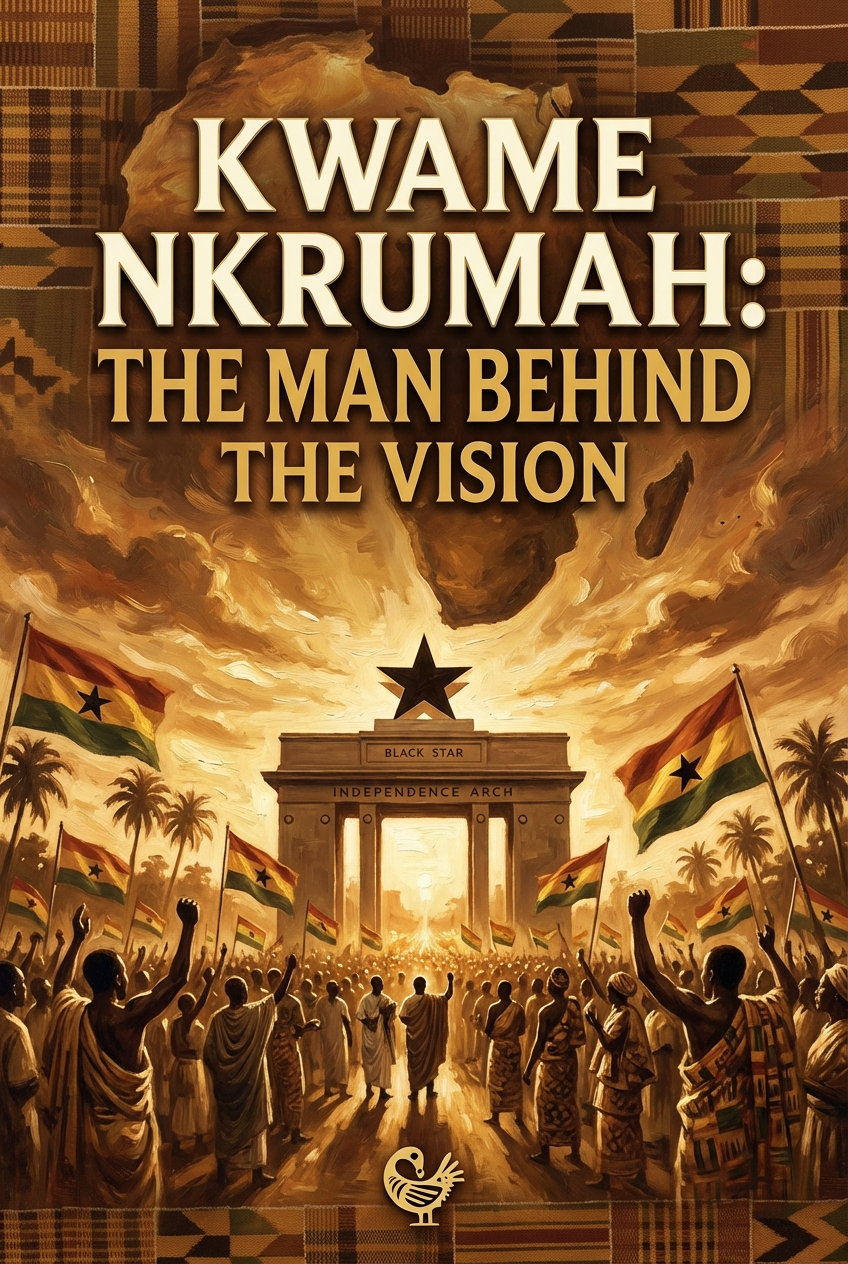
"Kwame Nkrumah: The Man Behind the Vision" delves beyond the iconic image of Ghana's first president, offering a nuanced portrait of Kwame Nkrumah as a complex individual shaped by profound experiences. The narrative begins in Nkroful, exploring Nkrumah's early life and education within the framework of colonial Ghana and his exposure to traditional Akan values, which would later influence his political thought. The book meticulously traces Nkrumah's decade-long sojourn in the United States, examining his intellectual development at Lincoln University and the University of Pennsylvania. It highlights his exposure to Pan-Africanist thought, particularly the works of Marcus Garvey and W.E.B. Du Bois, which solidified his commitment to African liberation. It also explores his involvement in student activism and his struggles with financial hardship, illustrating the challenges faced by many African students abroad during this period. The narrative then follows Nkrumah's pivotal years in London, where he immersed himself in radical political circles and co-founded the West African National Secretariat, positioning him at the forefront of the burgeoning anti-colonial movement. Crucially, the book examines Nkrumah's personal relationships, including his friendships and romantic entanglements, shedding light on the support networks that sustained him through periods of intense pressure and political persecution. The book dedicates considerable attention to Nkrumah's return to the Gold Coast and his leadership of the Convention People's Party (CPP), detailing the strategies he employed to mobilize popular support and challenge British colonial rule. It meticulously recounts the events leading to Ghana's independence in 1957, emphasizing Nkrumah's role as a visionary leader and his commitment to Pan-Africanism. The narrative does not shy away from the challenges of nation-building, exploring the complexities of Nkrumah's socialist policies, his increasing authoritarianism, and the eventual military coup that ousted him in 1966. Finally, the book reflects on Nkrumah's exile in Guinea and his lasting legacy as a champion of African liberation and a controversial figure in Ghanaian history.
About the Author
The study of Kwame Nkrumah and the independence era in Ghana has been shaped by generations of historians and political scientists, both within Ghana and across the diaspora. Scholars such as Dennis Austin, Richard Wright, and Basil Davidson offered early perspectives, often engaging directly with Nkrumah's political project. More recently, historians like Adu Boahen have provided critical reassessments, examining the complexities and contradictions of Nkrumah's rule. Biography is central to understanding the era -- works by David Birmingham and June Milne are key resources. The Institute of African Studies at the University of Ghana has been a vital center for research, producing invaluable primary sources and scholarly analyses. Contemporary researchers continue to explore Nkrumah's legacy, employing diverse methodologies to illuminate his impact on Ghanaian society, Pan-Africanism, and the global struggle for decolonization.
Key Themes
- Pan-Africanism
- Colonialism and Anti-Colonial Resistance
- Ghanaian Independence
- Nkrumahism
- Political Leadership
- Nation-Building
- Exile and Legacy
Why This Matters
The story of Kwame Nkrumah is pivotal for understanding Ghanaian and African heritage because it encapsulates the struggles and triumphs of the independence era. Nkrumah's unwavering commitment to Pan-Africanism and his role in securing Ghana's independence served as an inspiration for liberation movements across the continent. Studying his life allows us to grapple with the complexities of decolonization, the challenges of nation-building, and the enduring legacy of colonialism.
For the diaspora, Nkrumah's story resonates deeply, offering a connection to the continent and a reminder of the ongoing struggle for racial justice and self-determination. Students can learn from Nkrumah's successes and failures, gaining valuable insights into the dynamics of political leadership, the importance of historical context, and the complexities of shaping a nation's identity. Engaging with this story fosters a deeper appreciation for African history and the ongoing pursuit of social and economic justice.
Historical and Cultural Context
Nkrumah's life and work are intimately connected to the broader context of the African independence movements of the mid-20th century. His advocacy for a "United States of Africa" draws parallels with other Pan-Africanist visions articulated by figures like Marcus Garvey and Julius Nyerere. Within the Sankofa Library, this topic connects with materials documenting the rise of nationalism in other African countries, the impact of the Cold War on African politics, and the ongoing debates about the legacy of colonialism and neo-colonialism.