Keyboard shortcuts
- J: Next chapter
- K: Previous chapter
- T: Toggle table of contents
- Shift+S: Share book
- +: Increase font size
- -: Decrease font size
- Escape: Close modals
Chapter 1
Part 1
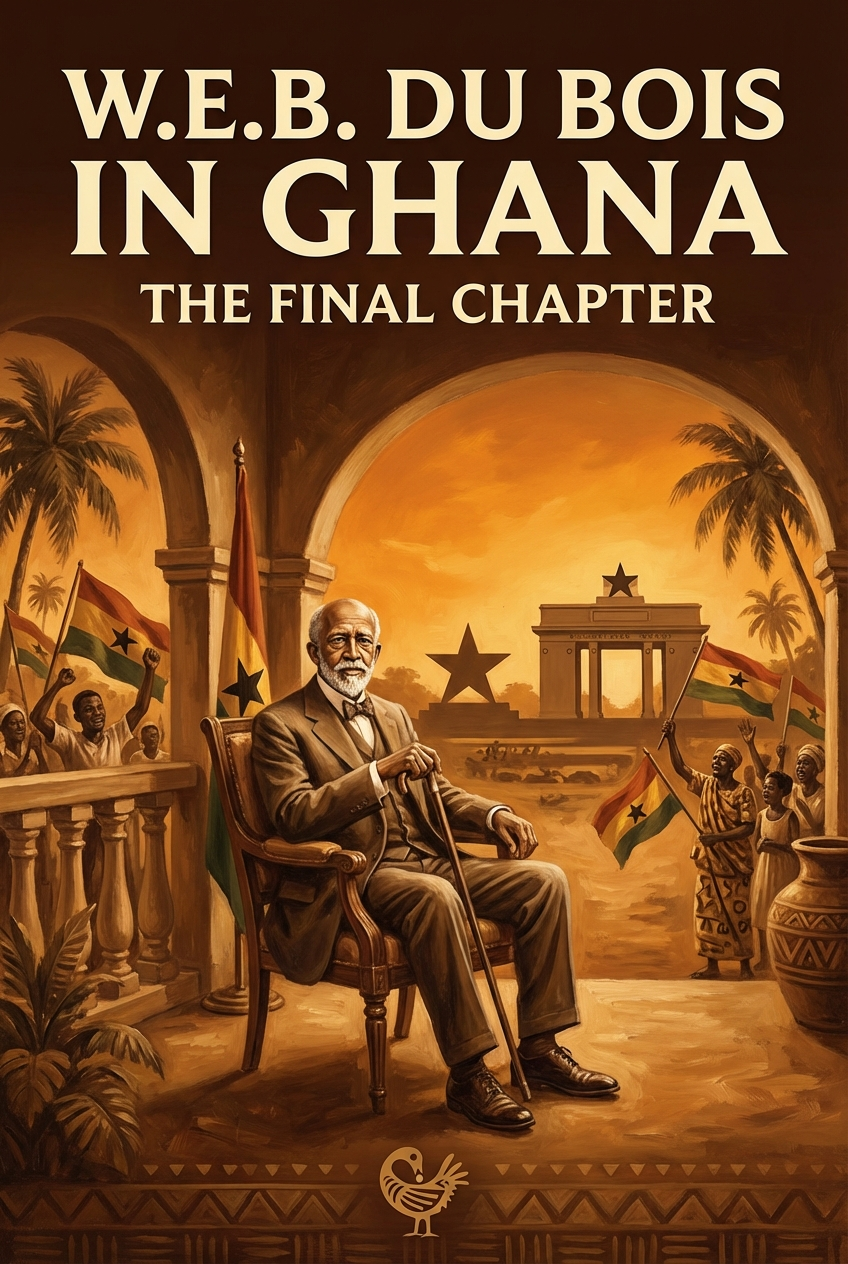
On October 1, 1961, at the age of 93, William Edward Burghardt Du Bois boarded a plane and flew to Accra, Ghana. He would never return to the United States. The man who had spent seven decades as arguably the most influential African American intellectual of the twentieth century, the co-founder of the NAACP, the author of "The Souls of Black Folk," and the relentless champion of Pan-Africanism, had chosen to spend his final years on African soil. His departure was not a comfortable retirement to a tropical paradise. It was a deliberate, politically charged act of renunciation: a Black American scholar, disillusioned by decades of racial violence, McCarthyist persecution, and what he saw as the fundamental bankruptcy of American capitalism, consciously choosing to become a citizen of the world's first independent Black African nation.
This story examines the final chapter of Du Bois's extraordinary life, focusing on his years in Ghana from 1961 until his death in 1963. It explores his complex and deeply personal relationship with President Kwame Nkrumah, the ambitious and ultimately unfinished Encyclopedia Africana project that consumed his final energies, and the profound symbolism of his decision to die in Africa on the very eve of the March on Washington, the largest civil rights demonstration in American history. The story of Du Bois in Ghana is not simply a biographical footnote. It is a meditation on exile, belonging, and the lifelong search for a place to call home.
The relationship between W.E.B. Du Bois and the concept of Africa was one of the defining tensions of his intellectual life. Born in 1868 in Great Barrington, Massachusetts, a small, predominantly white New England town, Du Bois had no direct personal connection to the African continent. His family had been free for several generations, and his childhood was shaped more by the rigid social hierarchies of New England than by any tangible African cultural heritage. Yet from his earliest scholarly work, Du Bois was drawn to Africa as both an intellectual subject and a spiritual anchor for the global Black experience.
His Pan-African activism began in earnest at the turn of the century. He organized and participated in a series of Pan-African Congresses beginning in 1900, bringing together intellectuals, politicians, and activists from across the African diaspora to discuss the political future of the continent. He argued passionately that the liberation of Black Americans was inseparable from the liberation of Africa itself. Colonialism, racism, and economic exploitation were, in his view, interconnected systems of oppression that could only be dismantled through coordinated global action.
About This Book
"W.E.B. Du Bois in Ghana: The Final Chapter" meticulously chronicles the twilight years of the towering Pan-Africanist intellectual, William Edward Burghardt Du Bois, as he embraced life in newly independent Ghana under the invitation and patronage of President Kwame Nkrumah. The book delves into Du Bois's motivations for relocating to Accra in 1961, exploring his disillusionment with American racial politics and his fervent belief in the potential of a united and liberated Africa. It details his symbolic renunciation of his United States citizenship, an act that powerfully resonated with the growing Black internationalist movement. A central focus is Du Bois's ambitious project, the Encyclopedia Africana, conceived as a comprehensive and authoritative repository of knowledge about African history, cultures, and civilizations. The book vividly depicts the daily life of Du Bois and his wife, Shirley Graham Du Bois, at their Cantonments residence, which served as the headquarters for this monumental undertaking. It explores the challenges they faced in assembling a team of scholars, securing funding, and navigating the complex political landscape of the era. Furthermore, the book examines Du Bois's close relationship with Nkrumah, analyzing the intellectual and political synergy between these two giants of Pan-Africanism. It sheds light on Nkrumah's vision for Ghana as a beacon of African liberation and his unwavering support for Du Bois's intellectual endeavors. The narrative culminates with Du Bois's death in Accra on August 27, 1963, the eve of the March on Washington for Jobs and Freedom -- a poignant coincidence that underscores the enduring relevance of his struggle for racial equality and social justice. The book considers the controversies surrounding his death and burial in Ghana, forever cementing his legacy in the nation's history. Readers will gain a nuanced understanding of Du Bois's intellectual contributions, his political activism, and his profound impact on the Pan-African movement, all viewed through the lens of his final chapter in Ghana.
About the Author
The scholarship surrounding W.E.B. Du Bois's time in Ghana builds upon a rich tradition of Pan-Africanist thought and historical inquiry. Early chroniclers like Shirley Graham Du Bois, his wife and a renowned writer herself, provided invaluable first-hand accounts. Later scholars such as David Levering Lewis, with his Pulitzer Prize-winning biography of Du Bois, offered critical perspectives on his life and work, examining his complex legacy. Academic institutions like the W.E.B. Du Bois Institute for African and African American Research at Harvard University have also played a vital role in preserving and promoting Du Bois's intellectual heritage. Ghanaian scholars have made significant contributions to understanding Du Bois's connection to the nation, highlighting the importance of his Encyclopedia Africana project and his relationship with Kwame Nkrumah. This body of work draws on archival materials, personal letters, and oral histories to paint a comprehensive picture of Du Bois's time in Ghana.
Key Themes
- Pan-Africanism
- Black Internationalism
- Encyclopedia Africana
- Kwame Nkrumah
- American Exile
- Intellectual Legacy
Why This Matters
The story of W.E.B. Du Bois in Ghana is profoundly significant for understanding Ghanaian and African heritage. It symbolizes the convergence of intellectual giants from the diaspora with the burgeoning independence movements on the continent. Du Bois's relocation to Ghana represented a powerful endorsement of Nkrumah's Pan-African vision and Ghana's role as a leader in African liberation. His commitment to the Encyclopedia Africana underscores the importance of reclaiming and celebrating African history and culture on African terms.
This topic remains relevant today, particularly for the diaspora, as it highlights the enduring connections between Africans and people of African descent worldwide. It encourages a deeper engagement with Pan-Africanism as a framework for addressing contemporary challenges. Students can learn from Du Bois's unwavering commitment to social justice, his intellectual rigor, and his lifelong dedication to the advancement of African people. Understanding his final years in Ghana provides a crucial perspective on the complexities of identity, belonging, and the ongoing struggle for racial equality.
Historical and Cultural Context
The story of Du Bois in Ghana is intricately connected to the broader context of the African independence era, a period marked by intense political upheaval and the rise of Pan-Africanism as a unifying force. Ghana's independence in 1957 served as an inspiration for other African nations striving for self-determination. Nkrumah's vision of a united Africa resonated deeply with Du Bois, who saw it as the culmination of his lifelong pursuit of racial equality and social justice. His work on the Encyclopedia Africana aimed to provide a counter-narrative to colonial representations of Africa, empowering Africans to define their own history and identity. This topic fits squarely within the Sankofa Library's mission of preserving and promoting African heritage, highlighting the intellectual and political exchanges that shaped the continent's trajectory during the 20th century.